PROPOSAL · concept study for the president · AI-generated renders show intent, not dielines · nothing here has been prototyped, quoted, or approved · 2026-08-28
Unicity · Unimate · packaging concept study
Unimate 7‑Day Trial Pack
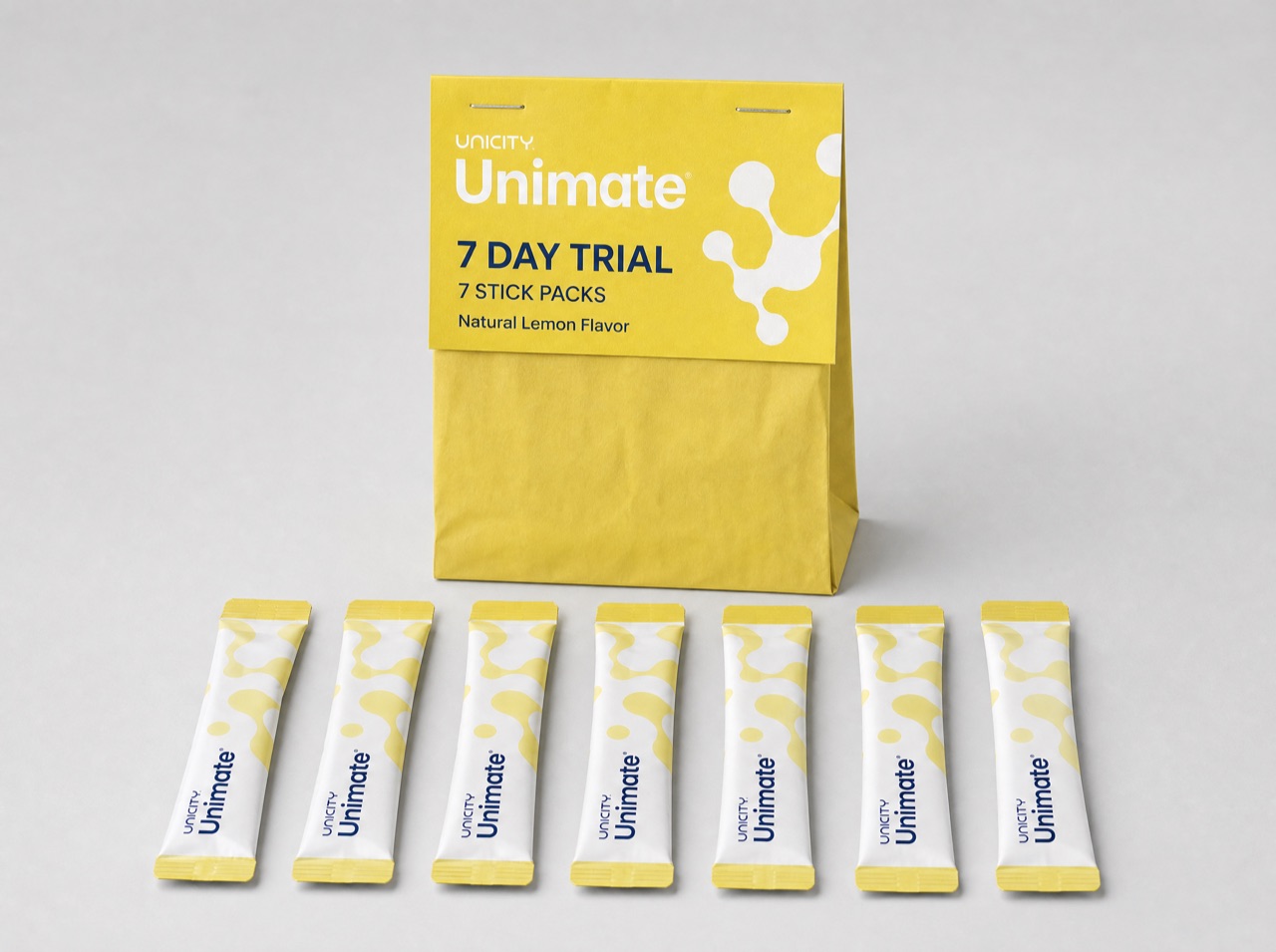
Four ways to put seven stick packs in a box that feels like Unimate, sized for a first week, and built to hand off to the 30‑count. Each concept comes with rendered shots, the reasoning behind the box type, what it should cost, and what has to be true before anyone cuts a die.
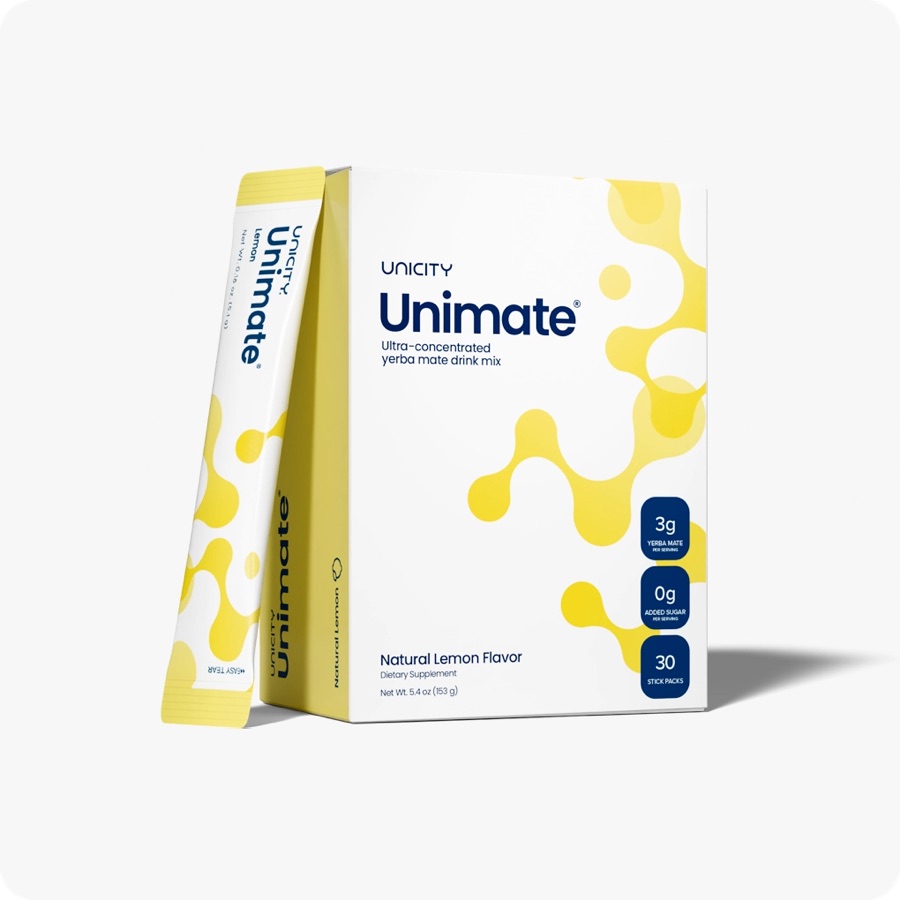
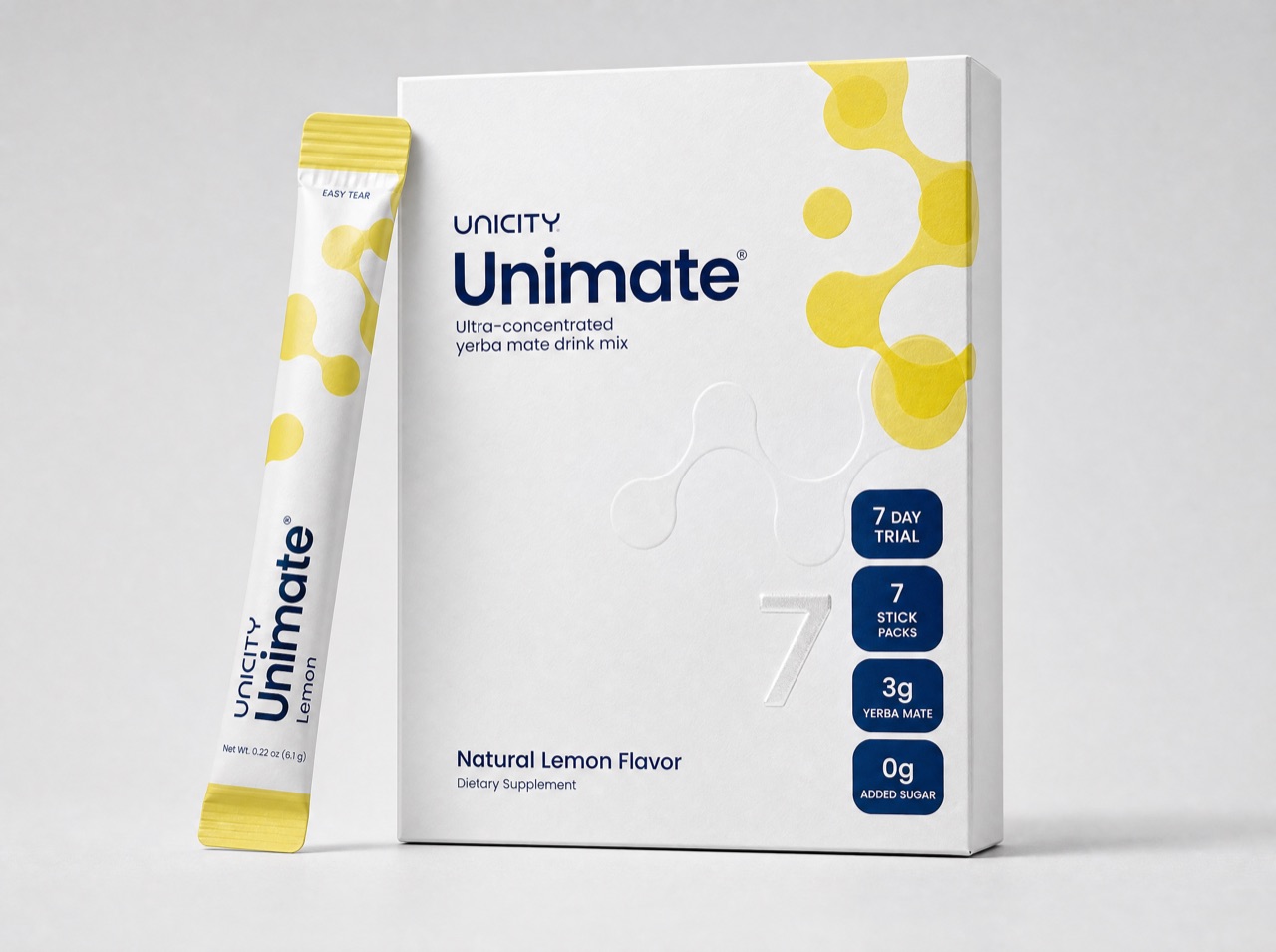
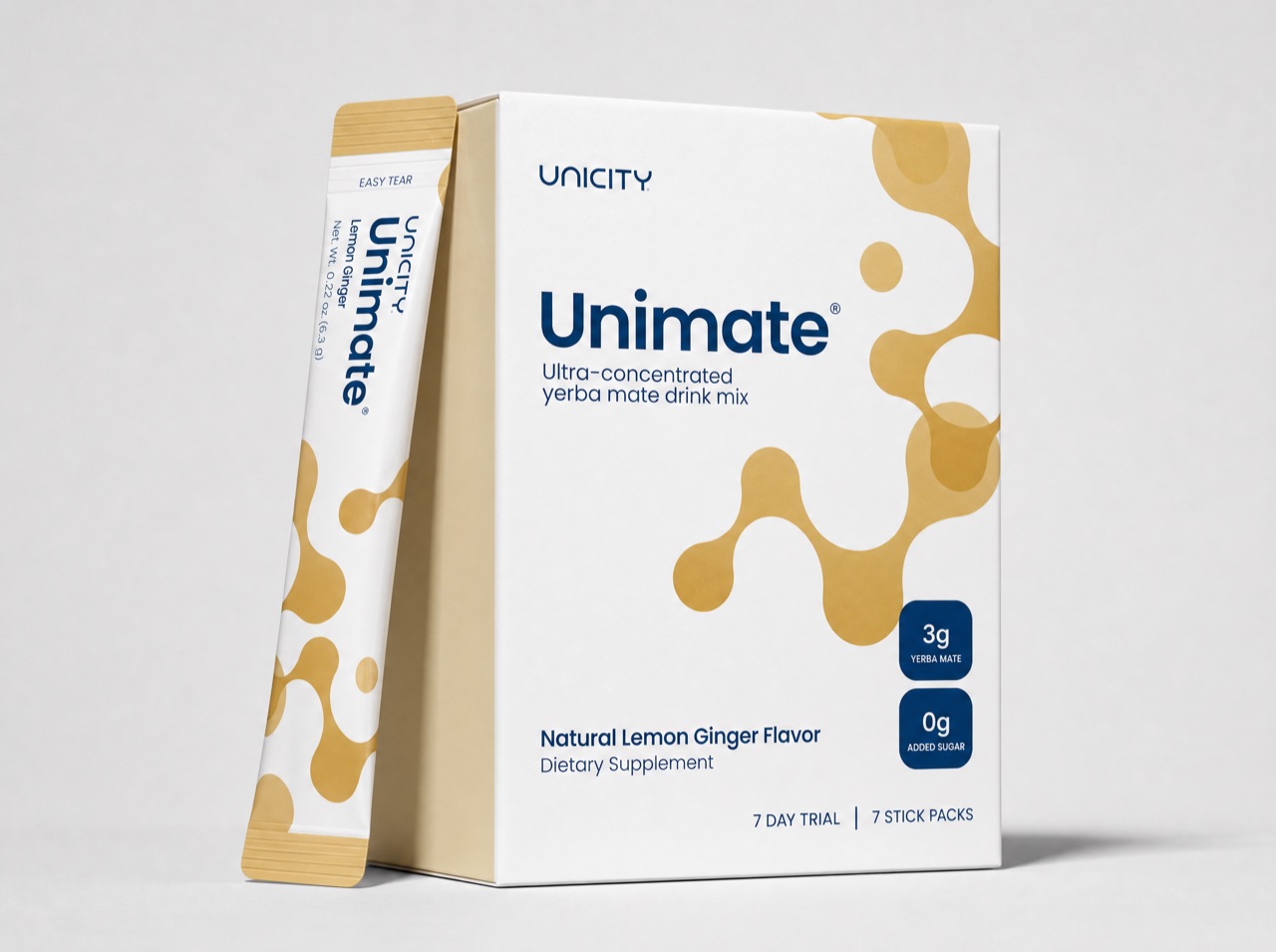
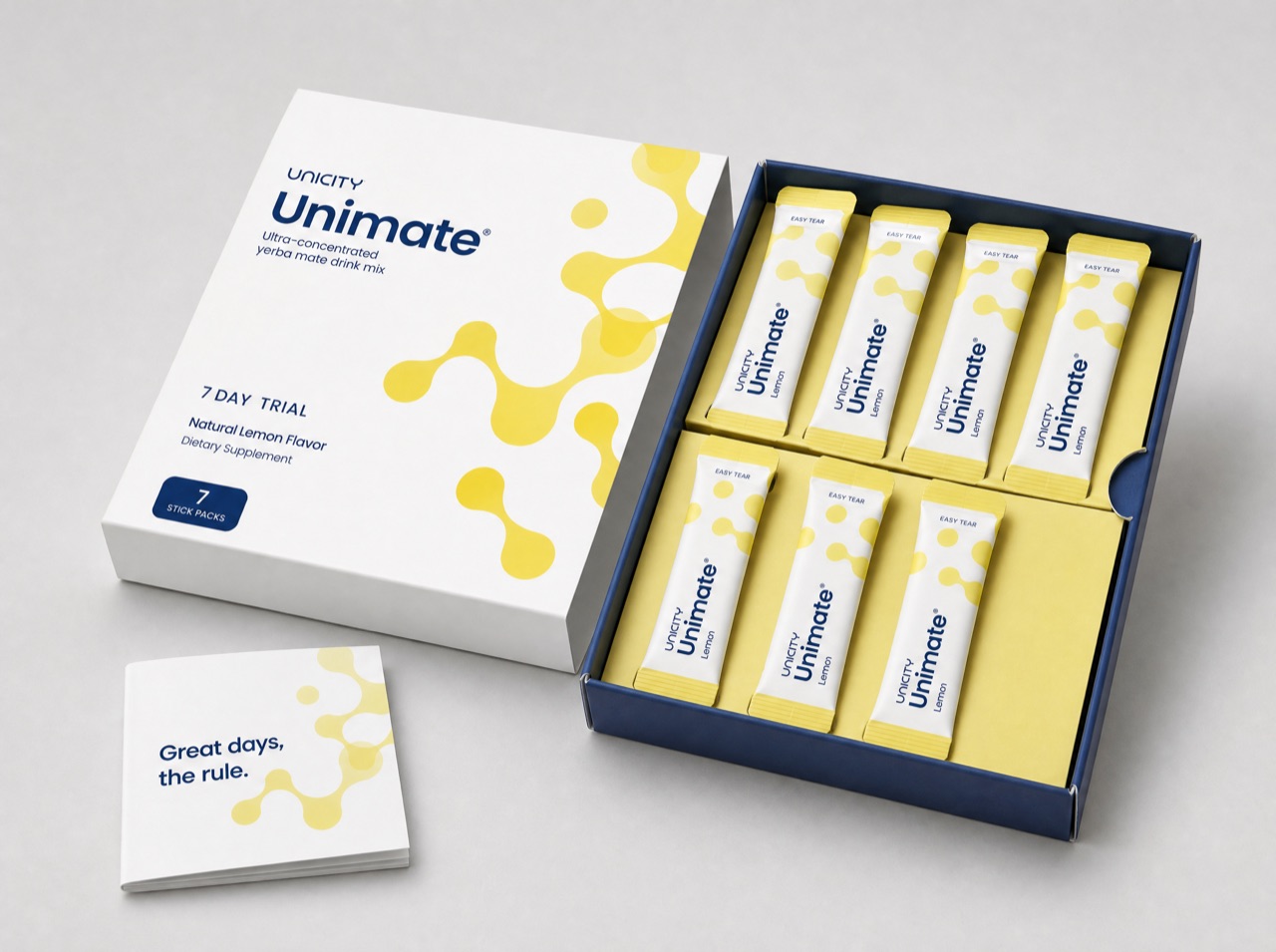
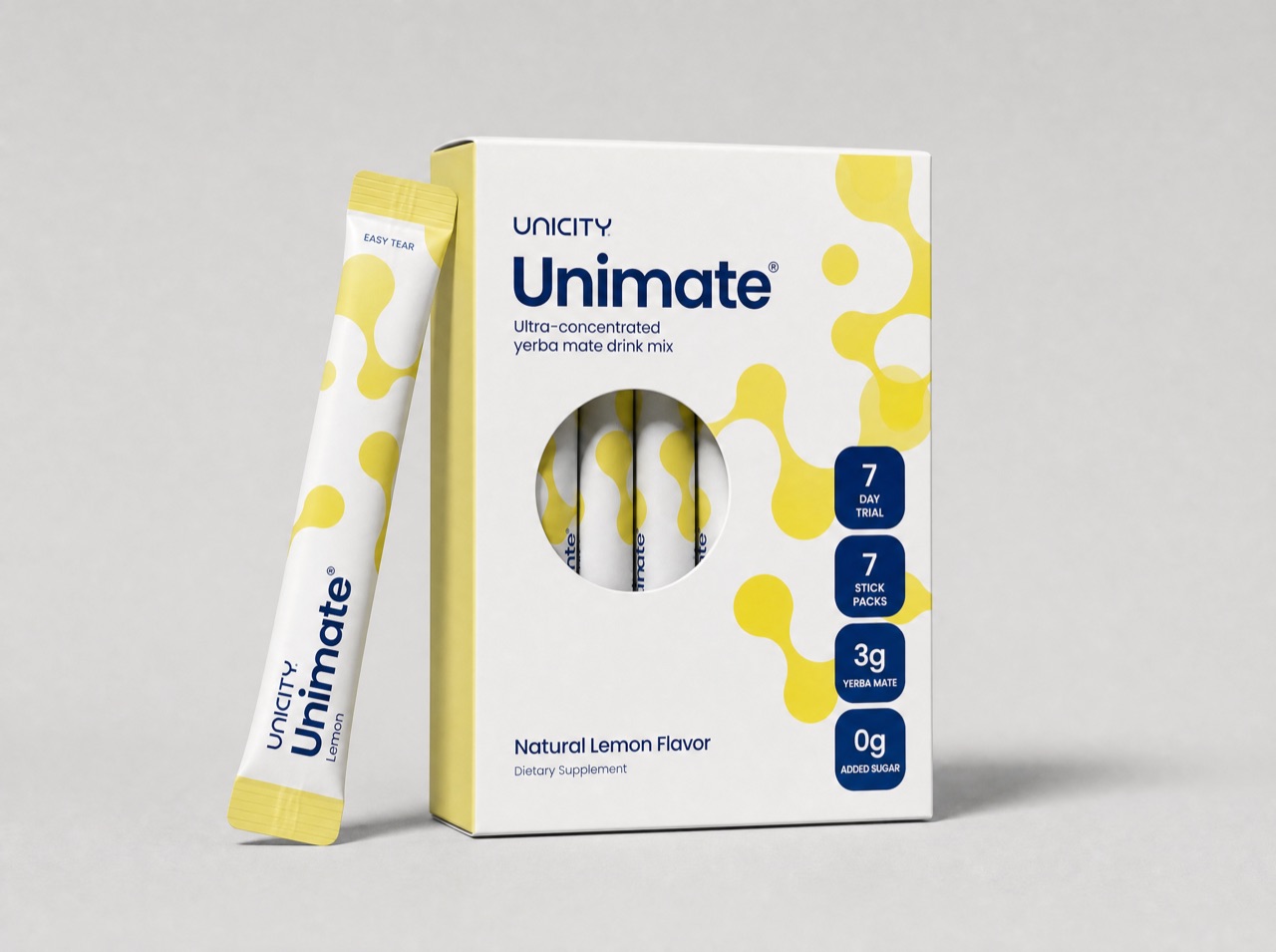
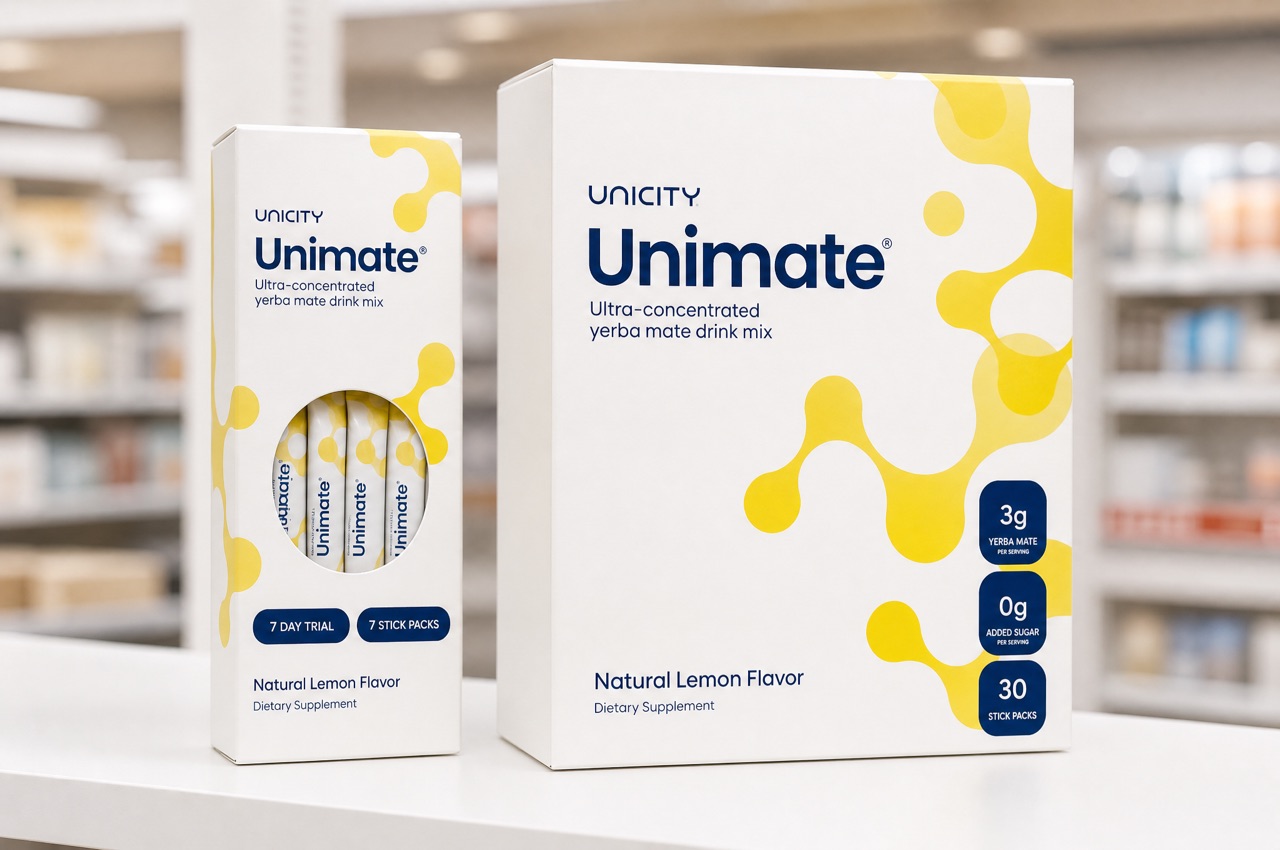
The box we are matching: today's 30‑count Natural Lemon carton (shop.unicity.com). Every concept below keeps its white board, navy wordmark, and yellow molecule graphic.
Working now (verified)
Unimate's public brand system, six flavor colorways, box copy, pricing ($115 / 30 sticks), and serving facts, read directly from Unicity's shop and product images.
How 16 comparable brands package and price 5‑to‑9‑stick trials, with sources.
20 concept renders generated from the real box photos (Higgsfield · GPT Image 2), each checked for spelling and brand fidelity.
Built but unproven
The four box structures exist only as renders and dimensioned specs. No physical prototype, no dieline, no supplier quote.
All box dimensions are built on an estimated stick size (≈150 × 35 × 6–7 mm). Nobody has measured a real stick yet.
Unit costs are supplier list prices, not quotes; dies, freight and hand‑assembly are extra.
Depends on someone else
Packaging team: real stick dimensions and how the 30‑count is packed inside.
Brand team: Brandfolder access for the official logo files, hex values, and typeface.
President / comp plan: sold SKU vs. gift‑with‑purchase, price, and PV assignment.
Legal: Supplement Facts, net weight, and caffeine / GLP‑1 wording for the panel.
1
The brand we are matching
Pulled from the live product pages and box photography on 2026‑08‑28. Official brand files live in a login‑only Brandfolder we do not have; everything here is what the public can see, which is also what a customer sees.
The layout grammar every flavor shares
White matte upright carton; a small all‑caps UNICITY wordmark sits above a large lowercase Unimate® in a rounded geometric sans (visually Poppins‑like), both in deep navy.
Subline “Ultra‑concentrated yerba mate drink mix.” Flavor line, “Dietary Supplement,” and net weight bottom‑left.
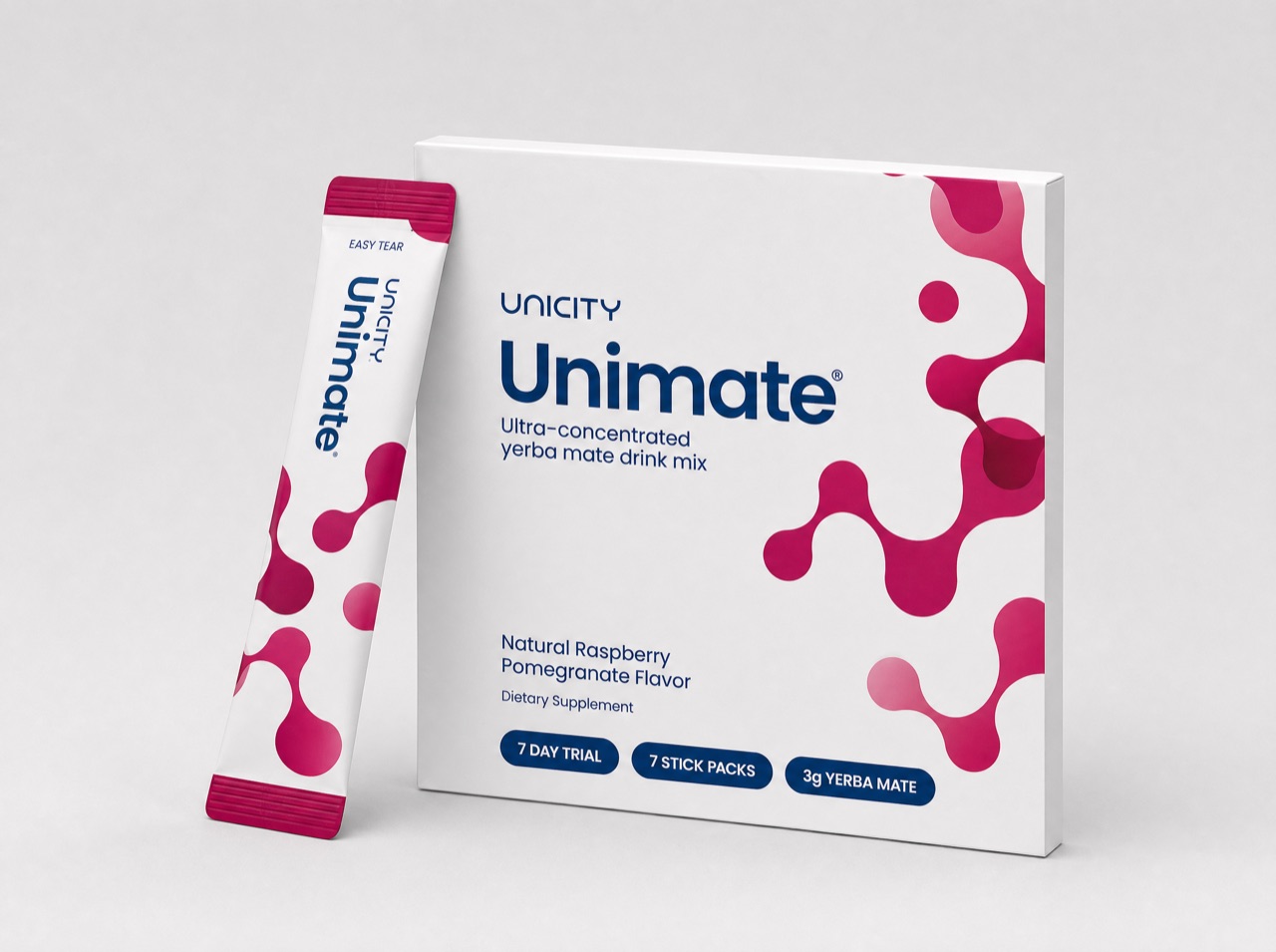
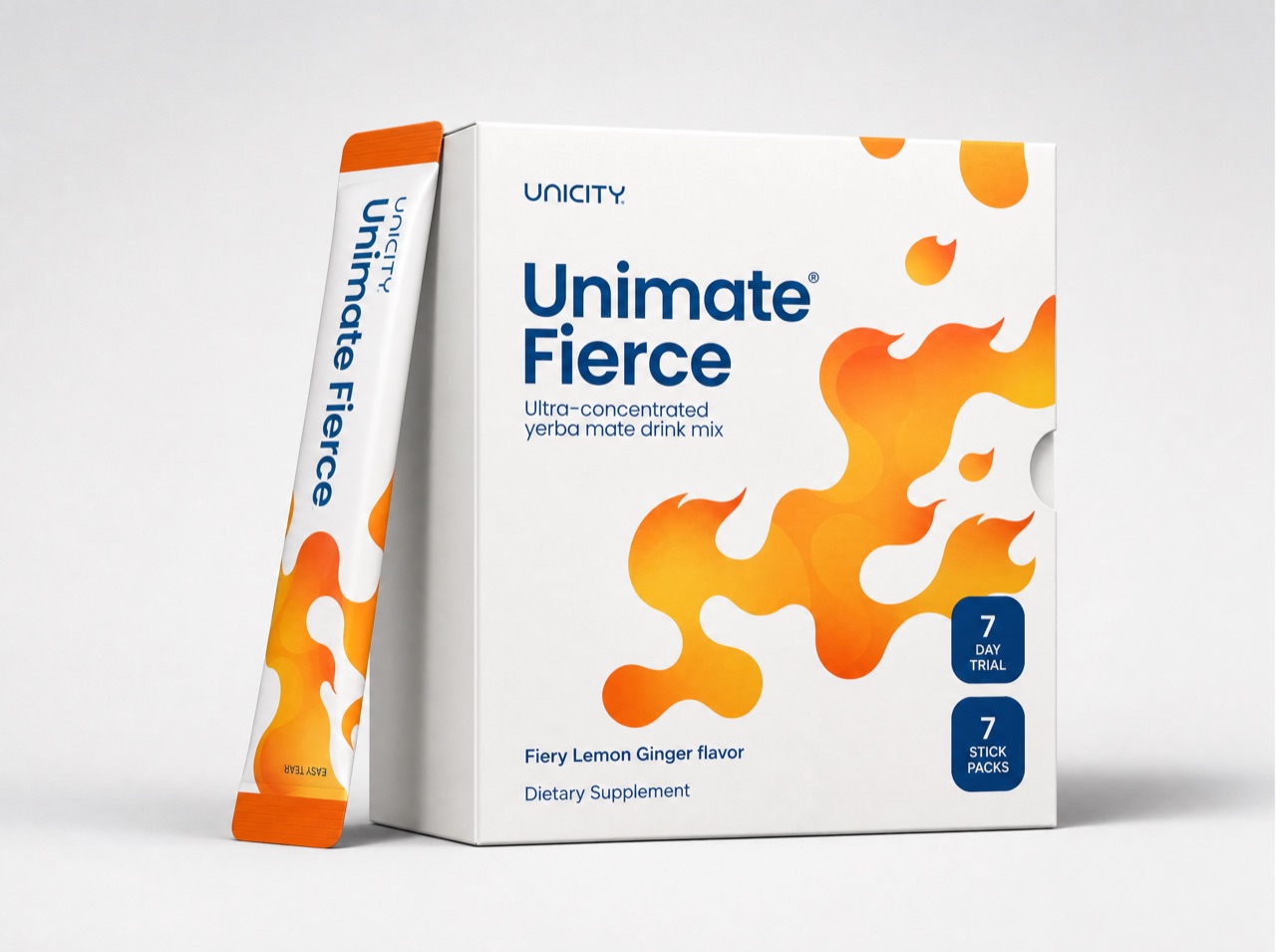
The molecule graphic: circles joined by short rods, with lighter translucent overlaps, flowing in from the top‑right in the flavor color. Fierce morphs the circles into flames.
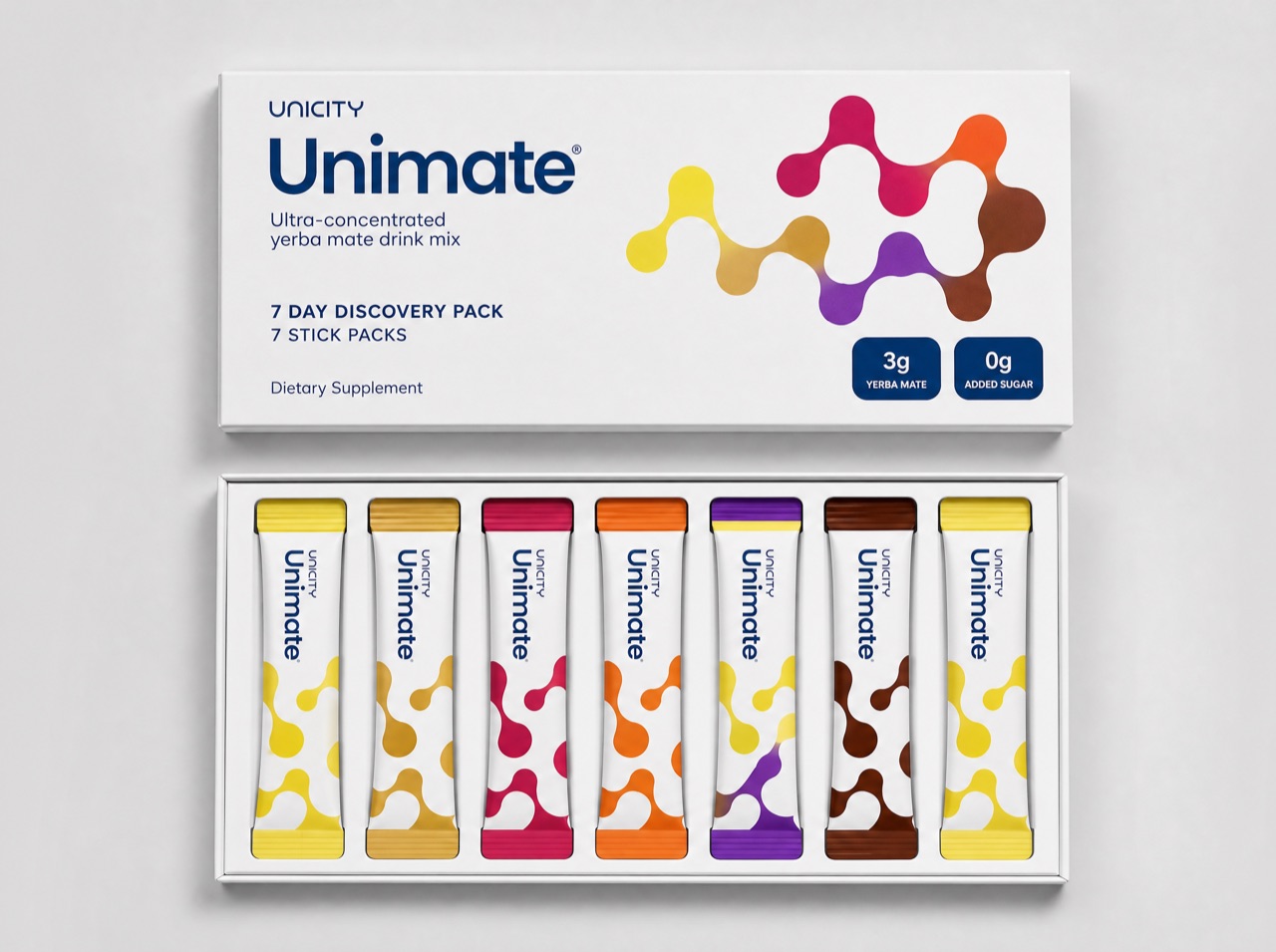
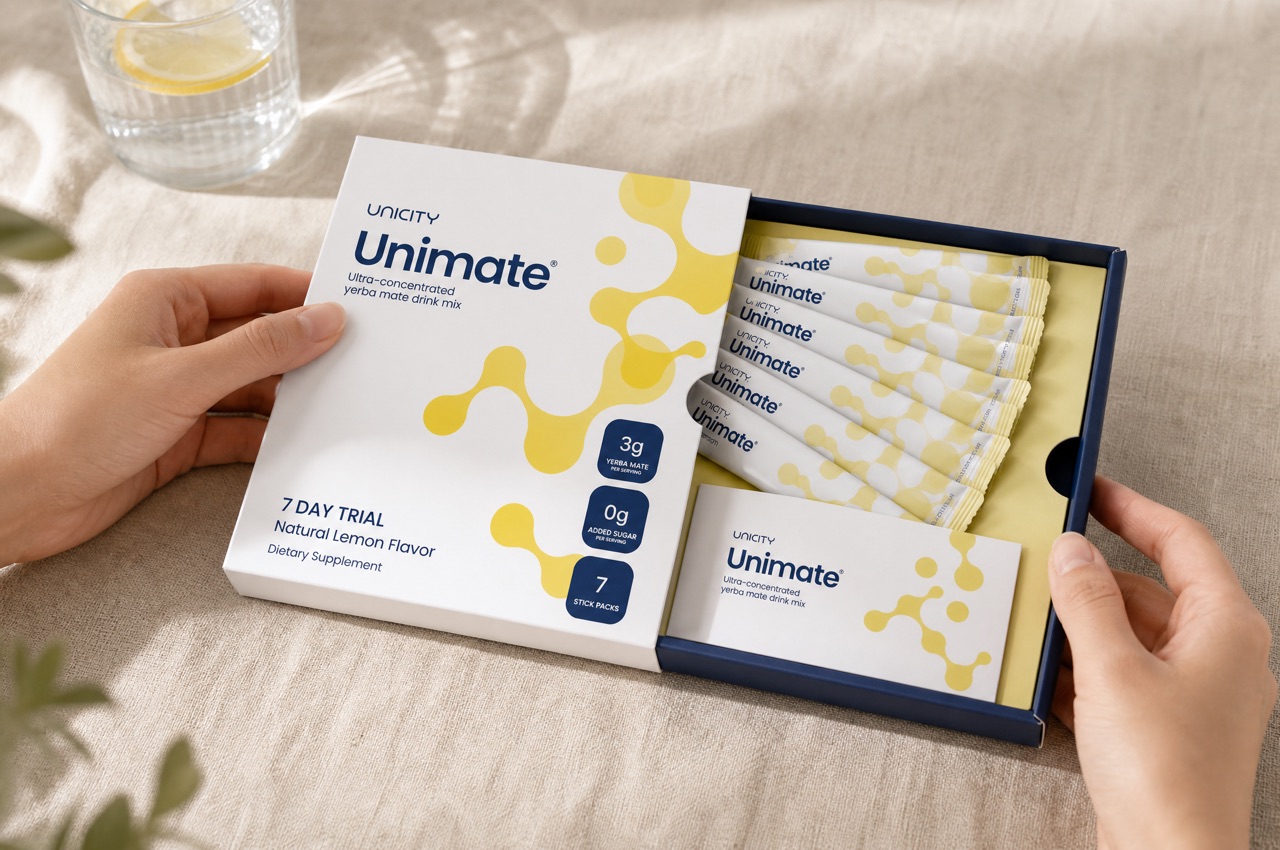
Three stacked navy pill badges bottom‑right: “3g YERBA MATE,” “0g ADDED SUGAR,” “30 STICK PACKS.” The trial pack only has to change the third pill.
Colored side panel with vertical “Unimate” + flavor name. Stick packs repeat the system: white film, colored blobs, navy wordmark, colored crimped ends, “EASY TEAR” notch.
Verified panel facts: 1 stick in 17–24 oz water, 1–2×/day · 5.1 g per Natural Lemon stick (5.4 oz / 153 g per 30) · $115 retail, $79 member → $3.83 / $2.63 per stick · no official trial or travel SKU exists in the US shop.
Sampled colors
Read from the box photo pixels and the site's logo SVG. Treat as working values until the Brandfolder confirms them.
#00296Cbox navy (print)
#153862UNICITY logo SVG
#F8DF38lemon molecule
#FAEC9Flemon overlap tint
#FAF0D6side panel
#FAFAFAwhite board
#003870pill navy
#CBA75Dsite gold accent
Six flavors, one system
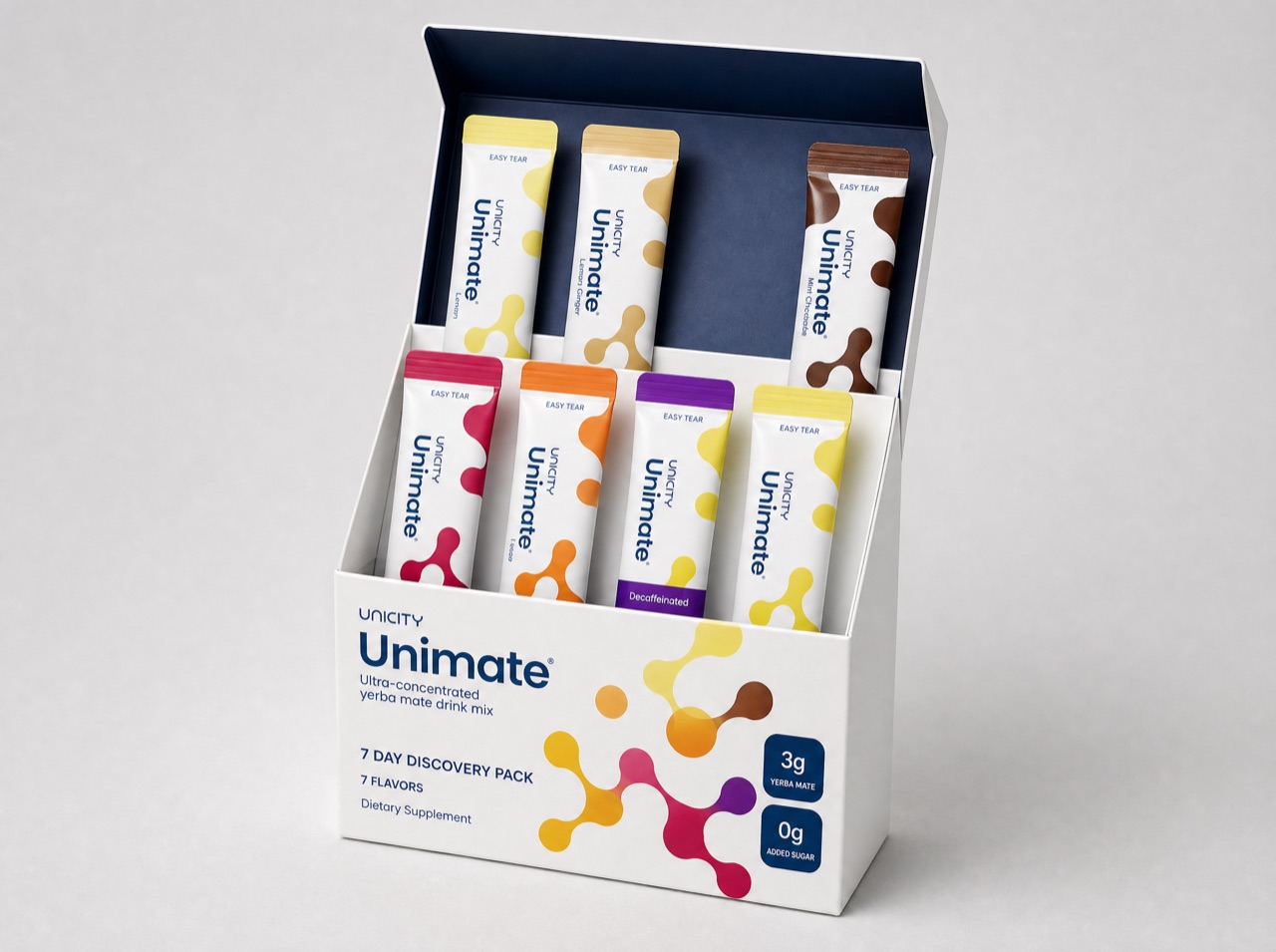
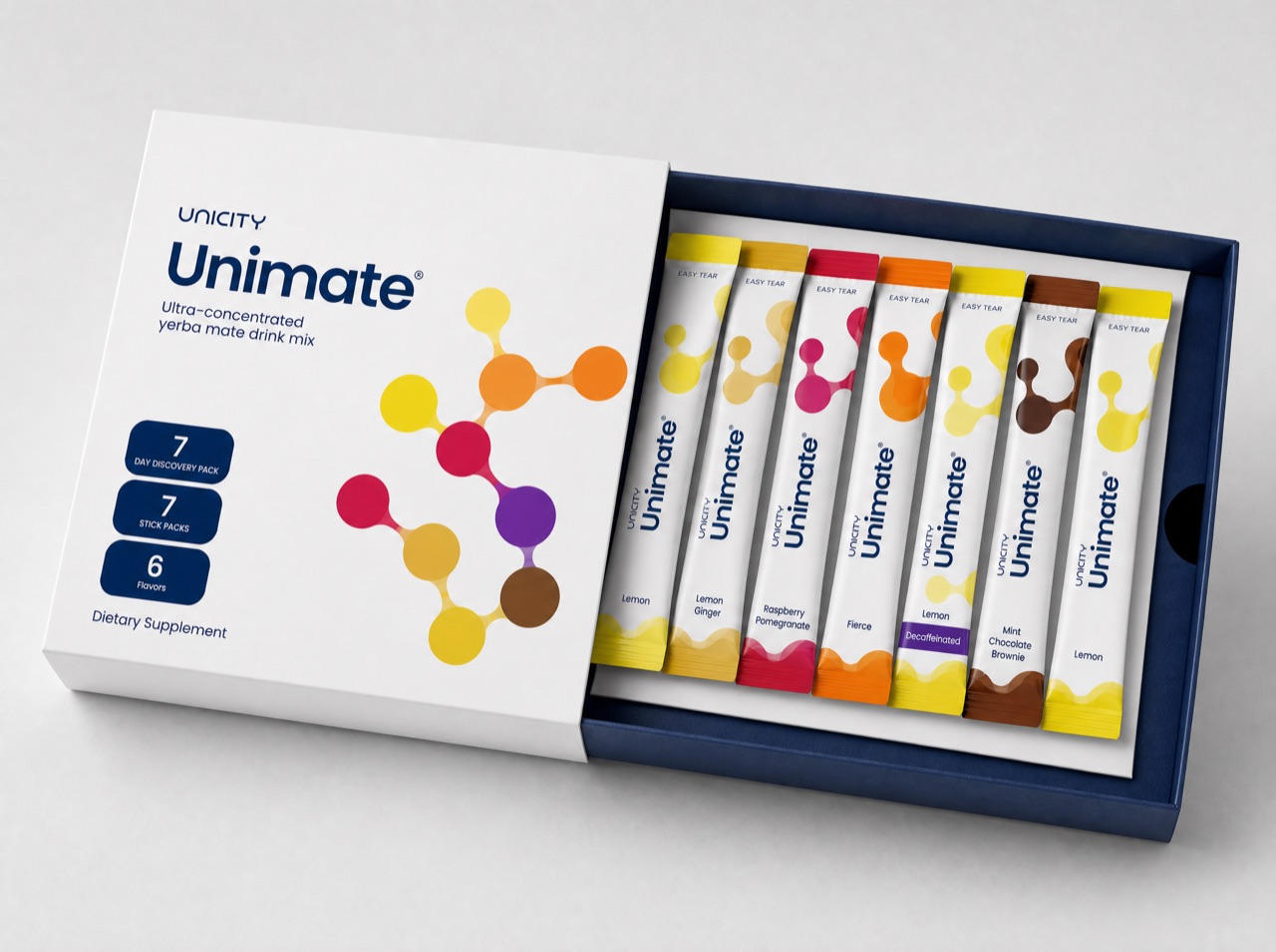
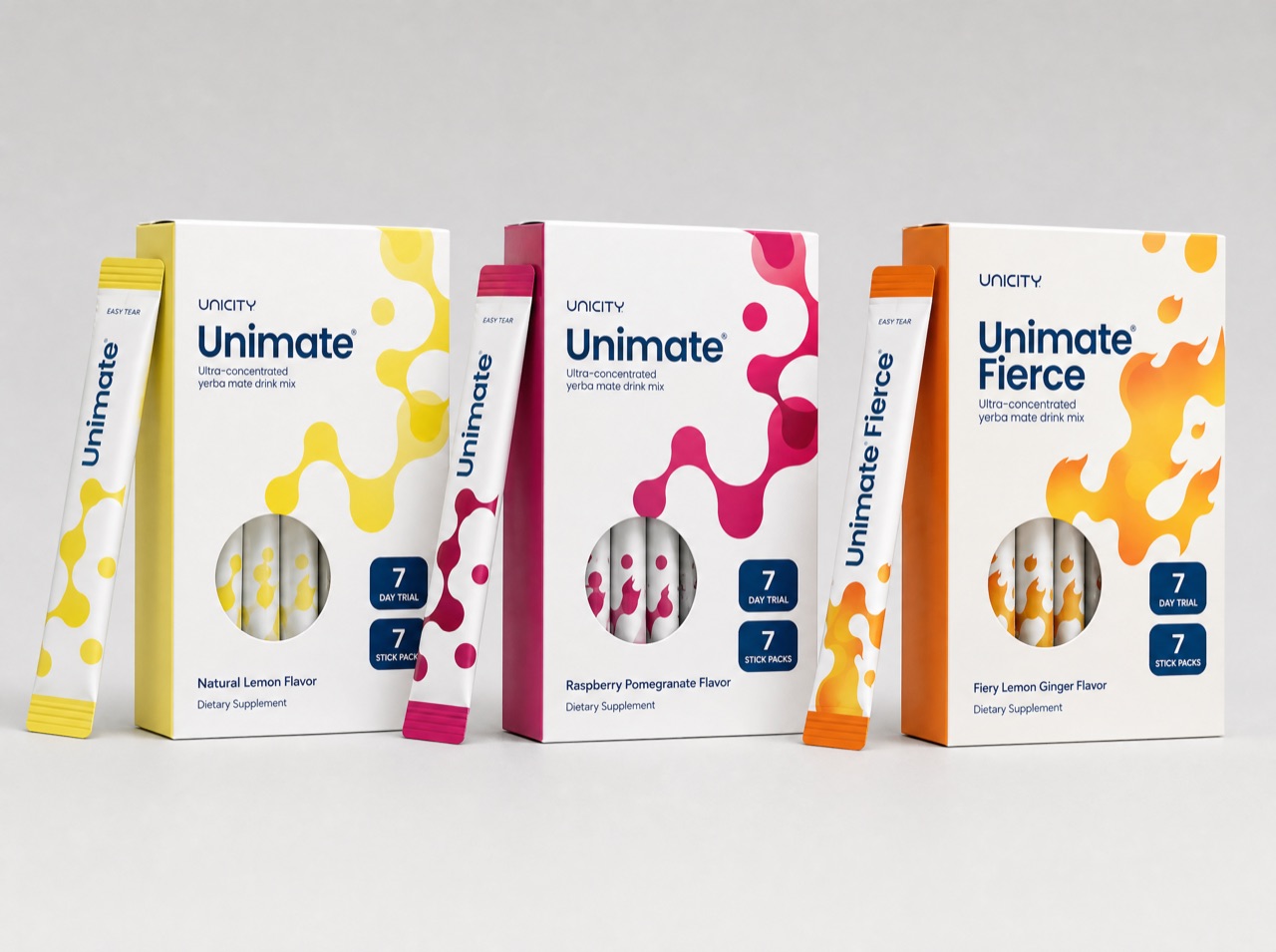
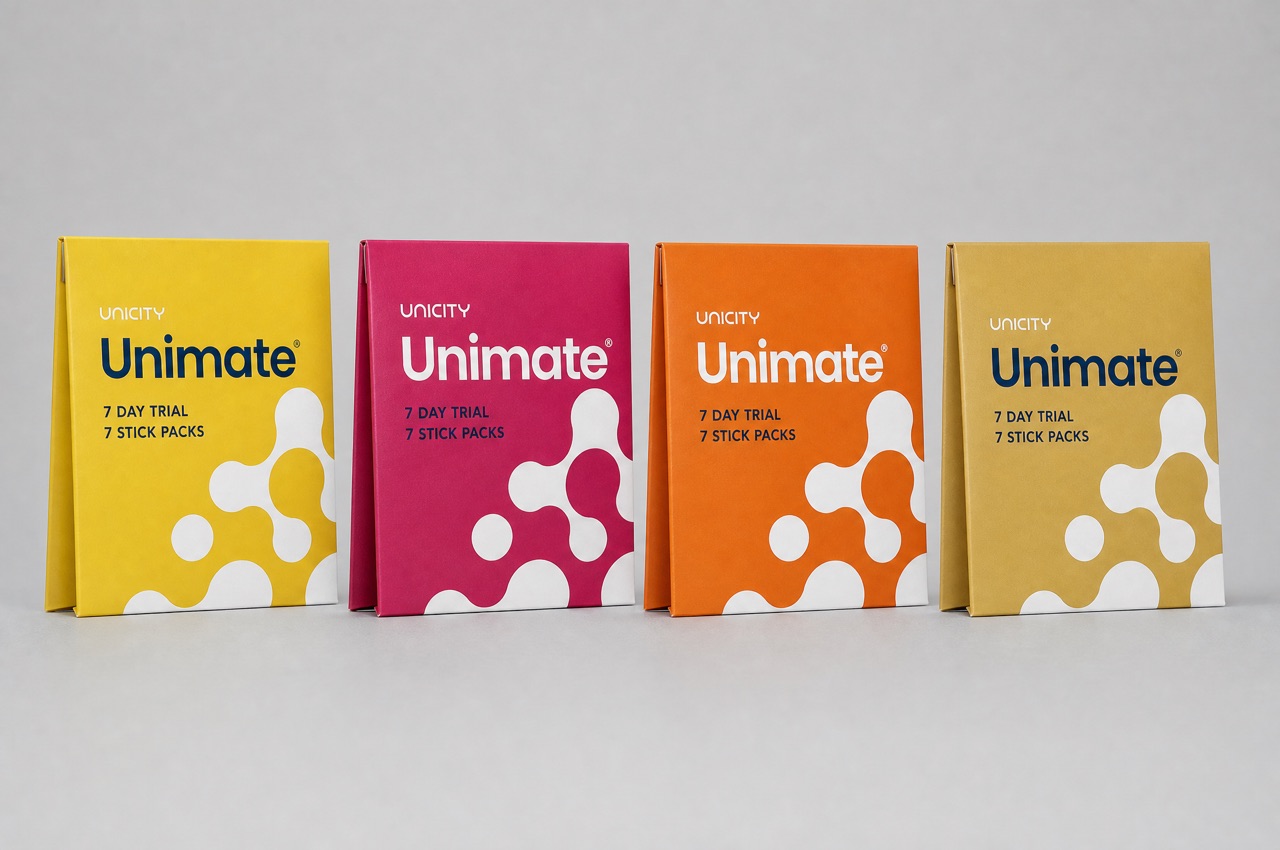
Flavor is carried by color alone, which is what makes a variety pack cheap to design: one die, print changes only.
Natural Lemon5.1 g · flagship
Lemon Ginger≈5.3 g
Raspberry Pom.≈5.8 g
Fierce5.2 g · flames
Decaf Lemon4.9 g · purple band
Decaf Mint Choc.≈7 g · dark box
2
What the market does with a small pack
Sixteen stick‑pack and starter‑kit brands. “Format” is the physical container; “mechanic” is how the small pack sells the big one. Tags: verified read on the brand's or retailer's page · likely reputable secondary source · inferred our own arithmetic.
#
Brand · pack
Count
Format
Size
Price
Mechanic
Conf.
1
AG1 Start Here Kit
7 sticks + shaker + habit journal
Retail kit box
—
$34.99 (Target)
Sold at retail as a “build a daily habit” starter; part of a 7 / 14 / 30 ladder
verified
2
LMNT Sample Pack
8 sticks, 8 flavors
Flat envelope pack
6.5 × 6.4 × 0.64 in
Free with purchase
Gift‑with‑purchase, one per order, via creator pages
verified / dims
3
Redmond Re‑Lyte Sample
7 sticks, 7 flavors
Pouch
—
$12.89
Sold; no credit toward full size
verified
4
Cure Hydration Starter Kit
8–9 sticks, one per flavor
Clear zip pouch
—
$19.99 / $18.39 sub
“Find your favorite, zero flavor commitment”
verified
5
Ultima Replenisher Trial
6 sticks, 6 flavors
Pouch / carton
—
$7.99
Named “Trial”; new customers 20% off + free shipping
verified
6
Waterboy Trial Pack
5 sticks, mixed
Small carton
0.91 oz
$9.99 DTC / $12.49 Target
Sold DTC and on shelf
verified
7
Liquid I.V. 6‑count
6 packets
Slim tuck carton
1.52 × 3.27 × 5.83 in
$9.29 (Target)
Low‑entry retail SKU, single flavor
verified
8
Liquid I.V. Variety Pack
16 sticks, 4 flavors
Resealable pouch
—
$27.99 / $19.59 sub
Variety pouch is the discovery vehicle; no free samples
verified
9
Factor Form 7‑Day Reset
7 greens + 2 whey + 2 hydration
Box
—
$29.99
Sold; 30‑day money‑back; no day labels
verified
10
Huel Black Variety Box
16 sachets, 8 flavors
Carton
—
$60
Sachets exist only for this box; free shaker on first order
No free samples; “Love‑It Guarantee” swaps flavors
verified
13
Emergen‑C 10‑count
10 packets
Flat tuck carton
4.1 × 2.64 × 1.97 in
$5.99 (Target)
Mass‑market small carton
verified
14
Vital Proteins 8‑count
8 sticks
Tall slim carton, sticks standing
1.93 × 6.1 × 7.36 in
$13.49 (Target)
Retail entry SKU
verified
15
ZOE Daily30+ 7‑day
7 servings
Dark‑silver pack
—
£10 intro → £13.50
7‑day retail tier under a monthly online pack; habit copy on the tear strip
likely
16
Seed DS‑01 Welcome Kit
30‑day jar + 1‑week travel vial
Rigid kit
—
$49.99 first order
Durable jar once, cheap refills after; subscription required
verified
What falls out of the table: stick brands almost never give product away. They sell 5–9 sticks for $8–$20, or gift 8 sticks with a full‑size order. Seven is rare (Redmond, AG1, Factor Form, ZOE). AG1 is the only brand that turned seven sticks into a $35 “starter” by adding a shaker and a habit journal. Seven Unimate sticks are $18 at member price, so a $19–$29 trial sits inside the category range.
Ten patterns that work, with the evidence
1 · Tie the count to a time period, not to “sample”
AG1 7‑Day Start Here Kit, ZOE 7‑day, Factor Form 7‑Day Reset, Tatcha “2 Week Introductory Set.” Habit research (Lally et al., 2010) shows automaticity builds fastest in the first days, so sell it as “your first week” and hand off to the 30‑box.
2 · Make the box count the days
Medrol Dosepak labels blister rows DAY 1–6; Care/of and Persona print the day on each tear‑off; Seed's lid has a twist day tracker; Sugalēs' sachet pattern fades across the box to show progress. Pharma vendors claim 15–27% adherence gains (directional, uncited).
3 · Include one durable or ritual object
AG1 shaker + journal; Seed glass vial; Huel shaker; MUD\WTR frother + guidebook; LMNT story card and booklet. This is what separates “trial” from “loose sticks in a bag.”
4 · Build in the path to the next purchase
Sephora's sampler carries a certificate for a free travel size; Magic Mind credits the $27 trial toward a subscription; Nespresso puts a $10 voucher in the machine box; SoPost recommends a QR straight to purchase. For Unimate: a QR that lands on a pre‑filled 30‑box cart plus a “pick your flavor” credit.
5 · Content first when the box opens
Blue Apron puts the welcome letter on top; Unicity's own Feel Great shipper already prints “Scan, Sip, Smile, Repeat” and five numbered steps inside the lid. The in‑house precedent exists.
6 · One dominant color, one tactile finish
LMNT: matte carton, spot gloss only on the stick photography and one phrase. DripDrop: deep blue, embossed logo. Prime: soft‑touch, two‑color print. Dieline's 2026 report files wellness under “Clinical With Soul” and “Rich, Not Snobby.”
7 · Restraint outside, personality inside
Waterdrop hides a lively inner carton under a quiet sleeve with a “Push” cue; üell and Kloo do the same. The outside earns trust; the inside earns the Instagram post.
8 · Photograph the sticks instead of cutting a window
None of LMNT, Cure, Waterboy, DripDrop, Prime, Waterdrop or AG1 use a window; they print the packets with spot gloss. A shaped window is distinctive precisely because it is rare, and it is also the most common failure point in transit.
9 · Variety is the trial vehicle in beverages
Celsius and Alani Nu discover through variety packs; Cure, LMNT, Redmond and Ultima put one of each flavor in the trial. Unimate's color‑per‑flavor system is already built for a mixed 7‑pack.
10 · Sampling converts when it is measured
SoPost: 32% of Boost Drinks samplers bought within two weeks (closest functional‑drink analog). Bazaarvoice: 63% (opted‑in review panel, so an upper bound). No published number exists for stick‑pack functional beverages; plan to measure with the QR landing page rather than quote one.
What reads cheap (avoid)
Loose sticks in a poly bag or clear pouch. Fine at $8, wrong for a $115 product.
Saying everything on the front panel.
Bright orange, yellow and red with no calm ground. Unimate's white field and navy type are exactly what keep its own colors from tipping over.
Cartoon mascots and anthropomorphic fruit (Dieline calls it dated).
Sterile clinical minimalism (Grüns paid to leave it behind).
Heavy foil and faux‑leather luxury cues.
Many finishes stacked on one small box. The premium examples pick one.
Thin board under 16 pt that shows print‑through or wavy edges.
3
Four box concepts, five shots each
Shared assumptions: seven stock stick packs (no new stick print), stick estimated at 150 × 35 × 6–7 mm with 3–5 mm clearance, one insert card of at least 5.5 × 3.5 in, and a regulatory panel on every structure. Each concept shows a closed hero, the open mechanic, a second flavor colorway, a mixed‑flavor “7‑Day Discovery Pack” edition, and one in‑context shot. Click any render to enlarge.
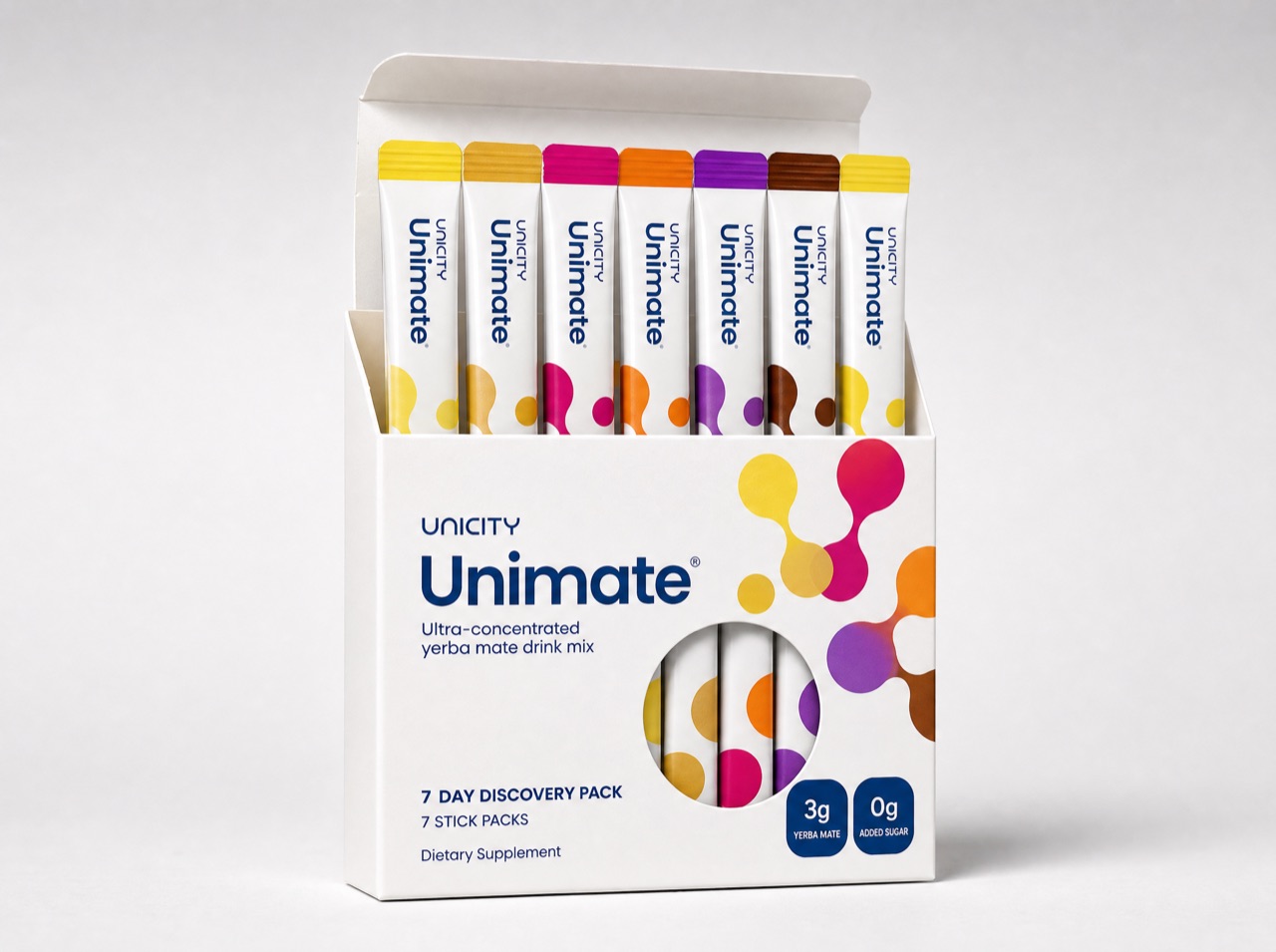
On the Discovery (variety) editions: Unimate has six flavors, so a seven‑stick pack always repeats one. The renders repeat Natural Lemon, the flagship. The other realistic option is six sticks plus a seventh of whichever flavor the customer picks. Flavor names are deliberately kept off the sticks and printed on the box: long names set vertically in 4‑point type are the first thing to fail on a real press, and they were also the first thing to fail in these renders.
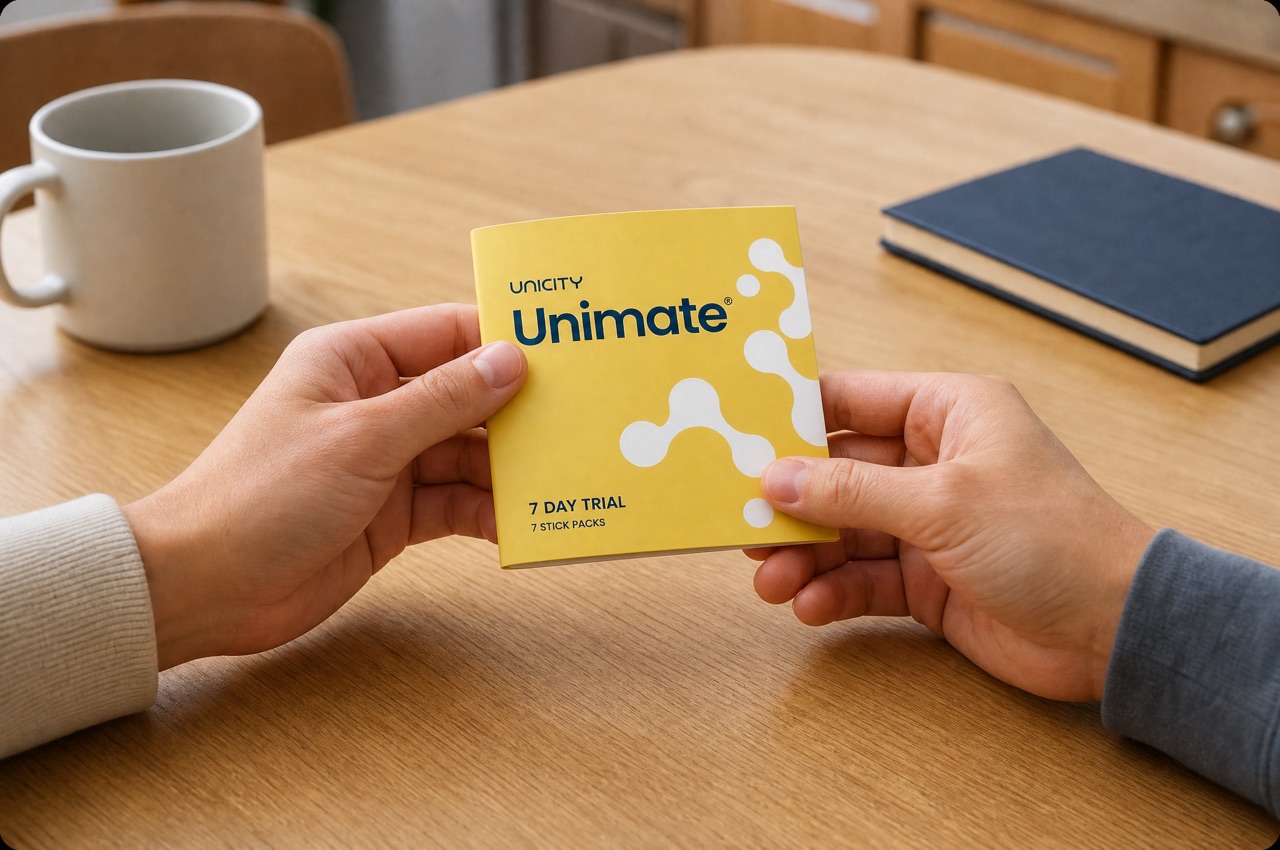
About the renders: AI‑generated concept images (Higgsfield · GPT Image 2) guided by the real box photographs. They show proportion, color, and intent. They are not dielines, and fine print on side panels is illustrative. Each render was checked by a second pass for spelling and brand fidelity; anything still flagged carries a small “QA” label.
A
First Week, Flat
Direct‑mail sleeve · the only one that mails as a letter
Built fordistributor direct mail, corporate lead seeding, event follow‑up
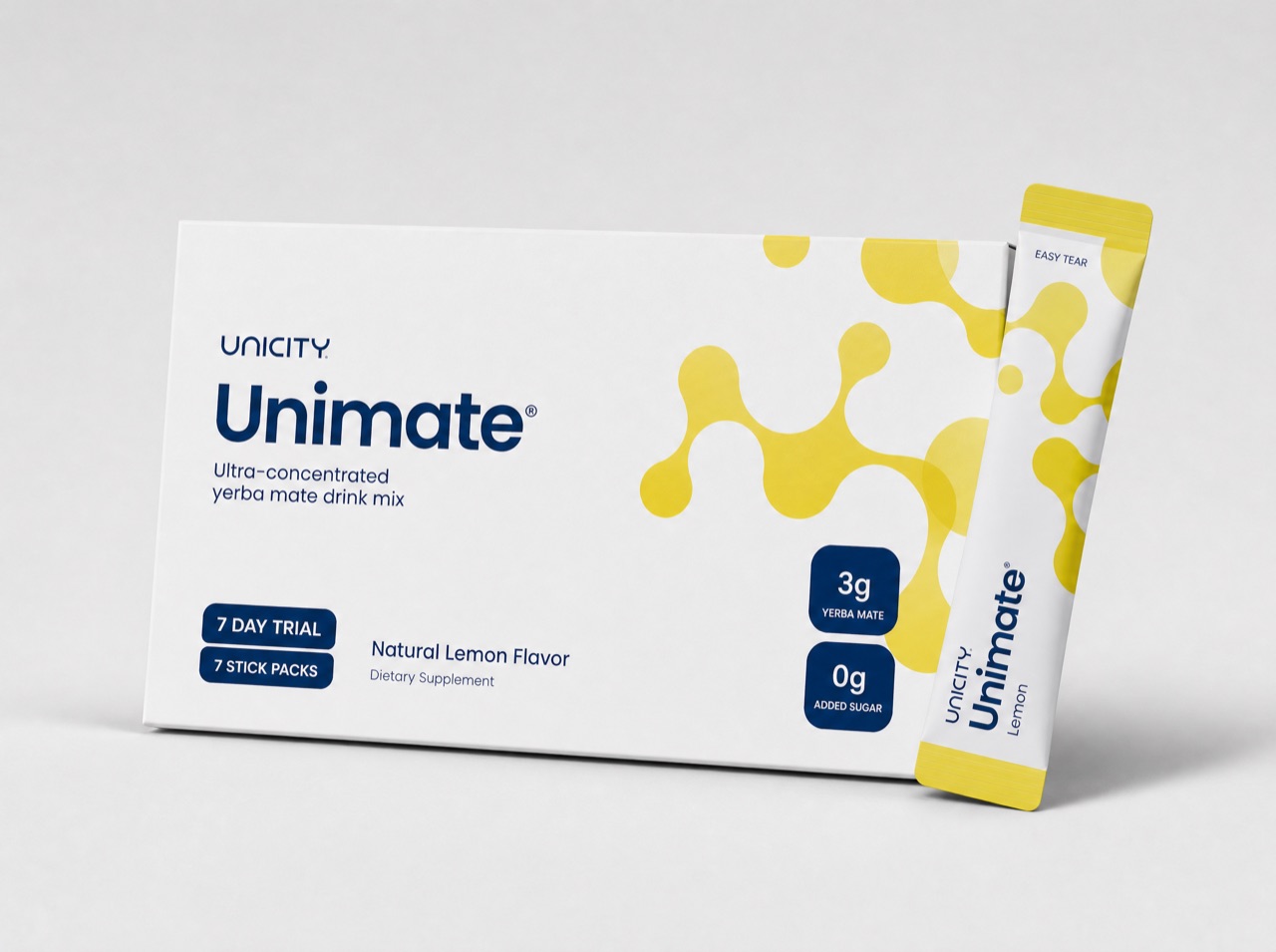
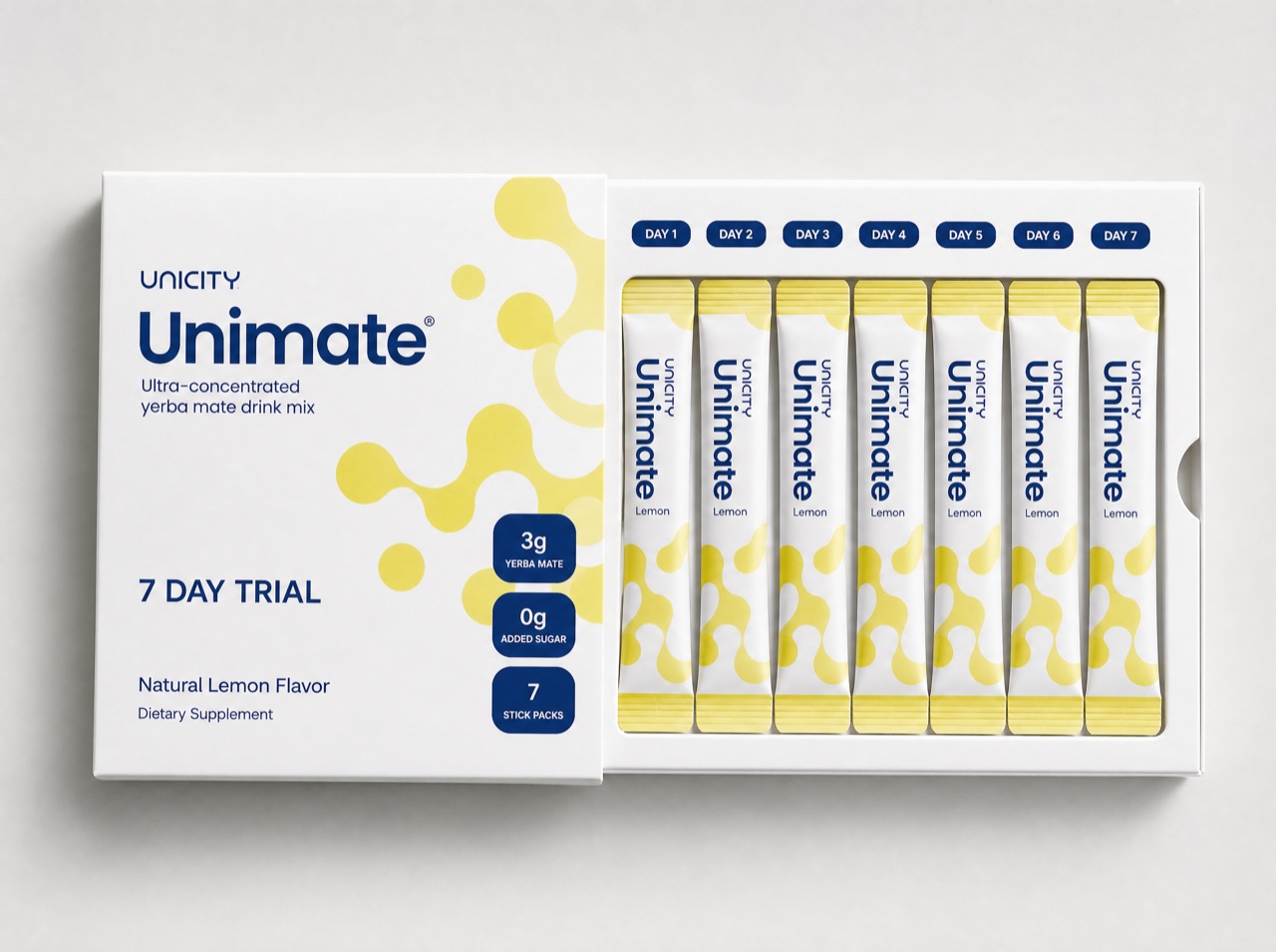
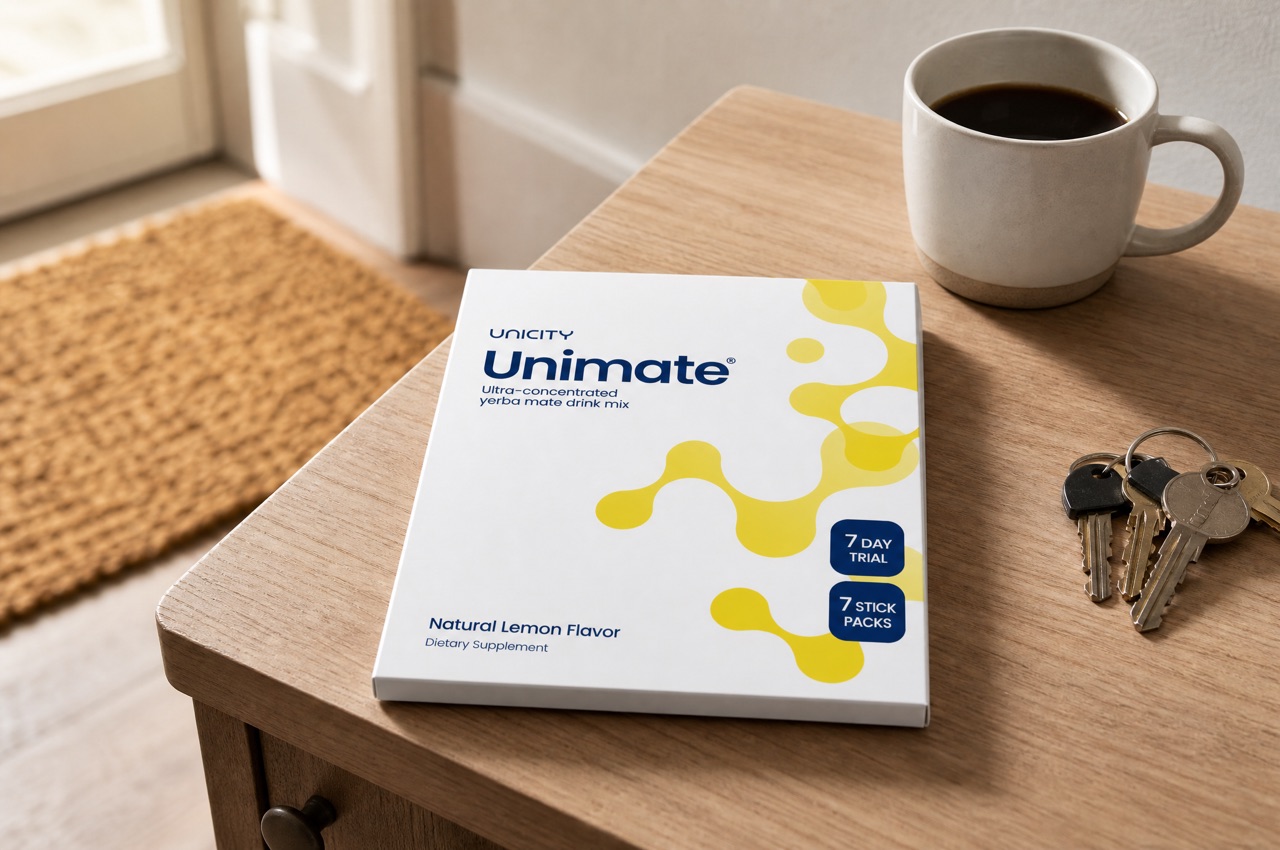
QA ✓Hero. Natural LemonThe closed mailer at rest: a quiet white sleeve thin enough to mail as a USPS flat for about $2 instead of a parcel, with the leaning stick pack showing how slim the whole piece is.QA ✓Open, the day strip revealedThe sleeve slides off to show the DAY 1 to DAY 7 holder card, the part that turns a sample into a one‑week habit while keeping all seven sticks in one flat row so the piece stays under USPS flat thickness.QA ✓Flavor. Raspberry PomegranateThe same sleeve in Raspberry Pomegranate proves one die and one layout cover every flavor, so adding a flavor is a print change only, not new tooling.QA ✓Variety. 7 Day Discovery PackA mixed‑flavor Discovery edition lets a lead taste the whole lineup in one week; flavor names stay off the sticks and live on the sleeve, which is also what keeps small‑type printing legible.QA ✓Life. Just DeliveredThe sleeve as it arrives, flat on an entry table with the morning mail, showing the direct-mail use case that justifies this structure over a box.
Spec sheet
Structure
Open‑ended paper sleeve wrapped around a die‑cut holder card with seven slits. Sticks lie in one row, held flat. No box, no glue.
Outer size
10.5 × 6.5 × 0.45 in · 267 × 165 × 11 mm. Copy is printed on the 10 × 6 in card itself, so no separate insert.
Board / finish
12–14 pt SBS sleeve, aqueous matte, spot UV on the seven stick photographs or the line “Great days, the rule.” Soy ink, FSC mark via the printer.
Motif
The card is a seven‑day strip, DAY 1 → DAY 7, each slot in the stick's flavor color, with a “DAY 8” QR to a pre‑filled 30‑box cart. Quiet white sleeve outside; the personality is on the card.
Ships as
USPS flat (large envelope ≤ 0.75 in thick, must bend) ≈ $1.90–$2.20 at 2–3 oz, against parcel rates for every other concept.
$0.60–1.20per unit @ 1k (digital)
$0.30–0.60per unit @ 5k (offset)
+ ≈$2 postageif it qualifies as a flat
Why this box
It is the only structure that can mail as a letter instead of a parcel. LMNT's Sample Pack is a 0.64‑in flat envelope for exactly this reason (market table, row 2).
The day strip borrows the Medrol Dosepak and Persona day‑labeling that pharma uses to lift adherence (pattern 2).
QR‑to‑cart is what SoPost recommends for measurable sampling (patterns 4 and 10). This is the concept that turns a mail drop into a conversion number.
Cheapest to print and ship at scale; no die for a box, one for the card.
Risks
If a filled stick is thicker than 7 mm or shifts in its slit, the piece fails USPS's ¼‑in thickness‑variance rule and reprices as a parcel, doubling postage.
A 10.5‑in‑wide sleeve has no shelf presence and cannot stand. Mail only.
Flexible sleeves scuff and dog‑ear in the mail stream; “premium” depends entirely on card weight and finish.
B
The Ritual Carton
Day‑numbered habit box · the one that builds the habit
Built fordistributor hand‑out at the kitchen table, first‑order gift, customer‑to‑customer gifting
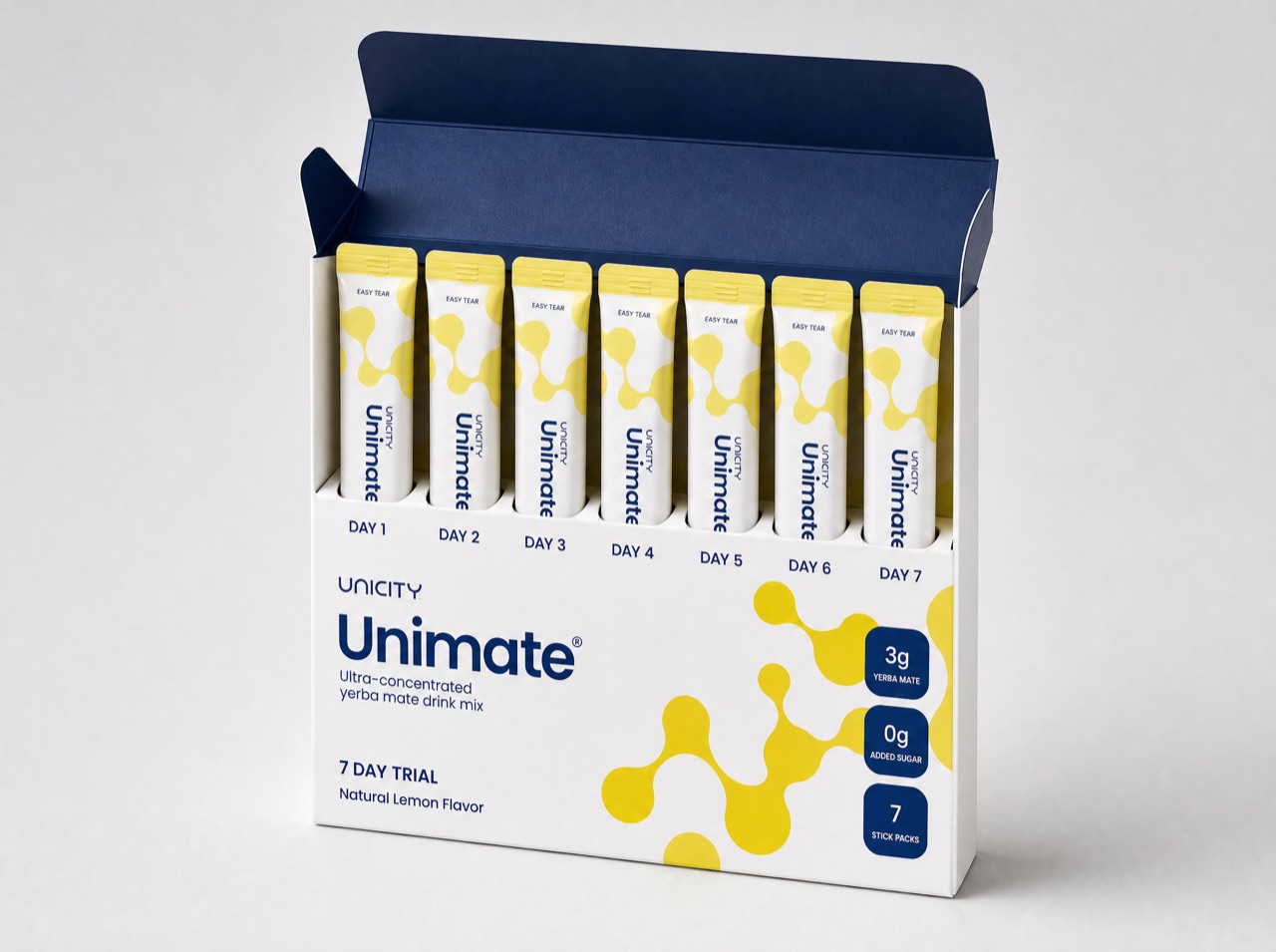
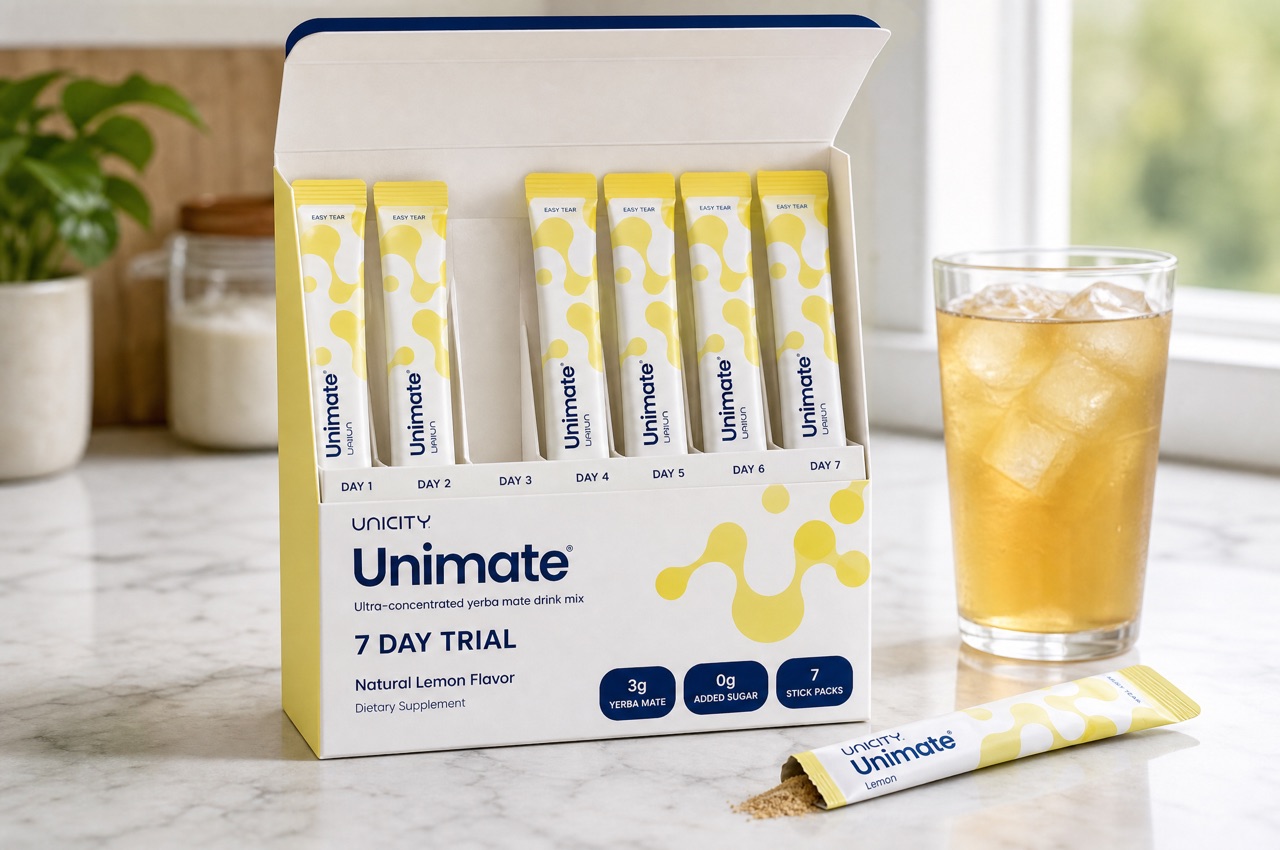
QA ✓Hero. Natural LemonThe closed carton next to a single stick shows the Ritual Carton is a compact near-square box that reads as family with today's 30-count pack while its quiet outside keeps the surprise for the inside.QA ✓Open, The Day CalendarOpening the lid reveals the concept's whole idea: seven sticks standing in day-numbered slots so the box doubles as a one-week habit calendar, the same starter-kit logic AG1 sells for $34.99.QA ✓Colorway. Lemon GingerThe same carton in the Lemon Ginger colorway proves one die and one layout serve every flavor, so adding flavors is a print change rather than new tooling.QA ✓Variety. 7 Day Discovery PackThe Discovery edition puts one stick of each flavor in the day slots, turning the same carton into a taste-test that helps a new customer pick the flavor for their first 30-count order.QA flag: vertical "Lemon" on the sticks renders mirrored — AI artifact, not a design choiceLifestyle. Day 3The empty Day 3 slot is the concept's whole argument: the box shows progress at a glance, the small daily cue habit research says carries someone from a trial into a subscription.
Spec sheet
Structure
Straight tuck‑end folding carton (both end flaps tuck on the same side, so the front panel stays clean), portrait, holding a bi‑fold insert card with seven die‑cut slits. Sticks stand upright; open the lid and you see seven stick tops in a row.
Outer size
6.5 × 6.2 × 0.95 in · 165 × 157 × 24 mm. Two rows standing (4 + 3), card between and around them.
Board / finish
18 pt SBS C1S, recyclable soft‑touch aqueous coating, blind emboss on the molecule cluster, one spot‑UV hit on the “7.” Inside of lid printed navy with the five Feel Great steps.
Motif
The card is the calendar: Days 1–4 on the left leaf, 5–7 on the right plus a “Day 8: your first box” panel with QR and a flavor‑choice credit. Empty slots reveal a printed progress fade so the box reads “Day 5 of 7” at a glance. Copy anchors the cue: “With your first glass of water.”
Ships as
Parcel (≈1 in thick, rigid) in a FEFCO 0427 mailer or padded envelope.
$0.75–1.50per unit @ 1k (carton + card)
$0.40–0.90per unit @ 5k
2 dies$350–800 each, carton + card
Why this box
AG1's $34.99 Start Here Kit (7 sticks + habit journal) is the market's proof that seven‑plus‑ritual sells as a starter, not a sample (row 1).
Seed's twist‑lid tracker, Care/of's daily packs and Medrol's DAY 1–6 rows are the direct design precedents (pattern 2); habit science supports naming a fixed daily cue (pattern 1).
Content‑first opening follows Blue Apron and Unicity's own Feel Great shipper lid (pattern 5).
Uses stock sticks, so day numbering lives on the card and no stick film is reprinted.
Risks
Two dies and a hand‑inserted card raise per‑unit labor; slits must be cut to the real stick or sticks fall out.
Nearly 1 in thick and rigid, so it ships as a parcel, with no letter‑rate mailing.
The Decaf Mint Chocolate Brownie stick is heavier (≈7 g) and brown; a mixed pack including it changes slot depth and breaks the white color story.
C
The Welcome Drawer
Premium rigid drawer box · the one that makes the gift
Built forgift‑with‑first‑subscription, executive and press seeding, high‑value leads
QA ✓Hero. Natural LemonThe closed box looks like the current Unimate carton from the outside but is a rigid, gift-weight object about the size of a paperback, signaling a premium first order rather than a sample.QA ✓Drawer Open. Natural LemonThis is the reveal the concept is built on: a quiet white outside, then a navy drawer slides out to show seven sticks fanned in color, the unboxing moment that brands like Seed and AG1 use to earn social posts.QA ✓Flavor Colorway. FierceOne box structure carries every flavor by print alone, so the same rigid tooling serves Fierce, Raspberry Pomegranate or Decaf without new dies or a new tray insert.QA ✓7-Day Discovery PackThe variety edition turns the drawer into a flavor sampler across all six Unimate flavors, which lets a new customer pick their 30-count box with confidence; the heavier brown Brownie stick fits because sticks lie flat in channels rather than standing in slots.QA ✓Gift Moment. LifestyleShows the box doing its actual job, being opened as a gift at a kitchen table; this is the moment that justifies a $3–6 rigid box, but only when it rides along with a subscription order rather than sold on its own.
Spec sheet
Structure
Rigid drawer box (matchbox style: a sleeve with a sliding tray and thumb notch). Tray fitted with a paperboard or molded‑pulp insert with seven angled channels, a 4.25 × 4.25 in booklet on top, and one durable object (collapsible cup or reusable straw) in a side well.
Outer size
7.0 × 6.5 × 1.5 in · 178 × 165 × 38 mm. Sticks lie flat in 4 + 3 channels.
Board / finish
1,200–1,500 gsm greyboard wrapped in 157 gsm art paper, soft‑touch lamination, navy exterior with a single white UNICITY wordmark; tray interior in flavor yellow. One foil or emboss element only.
Motif
Two‑layer reveal. Quiet navy outside; pull the drawer and seven colored sticks fan out in a curve under “Great days, the rule, not the exception.” Optional “To / From” field on the booklet for distributor personalization.
Ships as
Parcel. Rigid boxes arrive assembled, so freight and storage cost several times a folding carton's.
$3.00–6.00per unit @ 1k (box + tray + booklet)
$2.00–4.00per unit @ 5k
MOQ ≈ 300typical for rigid
Why this box
Seed, AG1 and MUD\WTR prove the “premium first box, cheap refills” model (rows 1, 16; pattern 3).
Torriden and Tatcha show that a structural reveal drives social posting, and the drawer is the reveal (pattern 7).
PackMojo's own guidance places rigid boxes exactly here: gifting and unboxing‑led DTC, not high‑velocity retail.
It is the only concept that can carry a durable object without looking padded.
Risks
Unit cost can approach a quarter of the trial's likely retail price; the economics only work as a gift tied to a subscription order.
Does not ship flat, so warehouse footprint and inbound freight rise sharply.
Dieline flags “ostentatious luxury” as dated; one finish and one wordmark or it reads as a perfume box, not a wellness habit.
D
The Shelf Window
Retail and pack‑out tuck carton · the one that sits on the shelf
Built for“add to any order” on shop.unicity.com, distributor pack‑out in volume, future third‑party retail
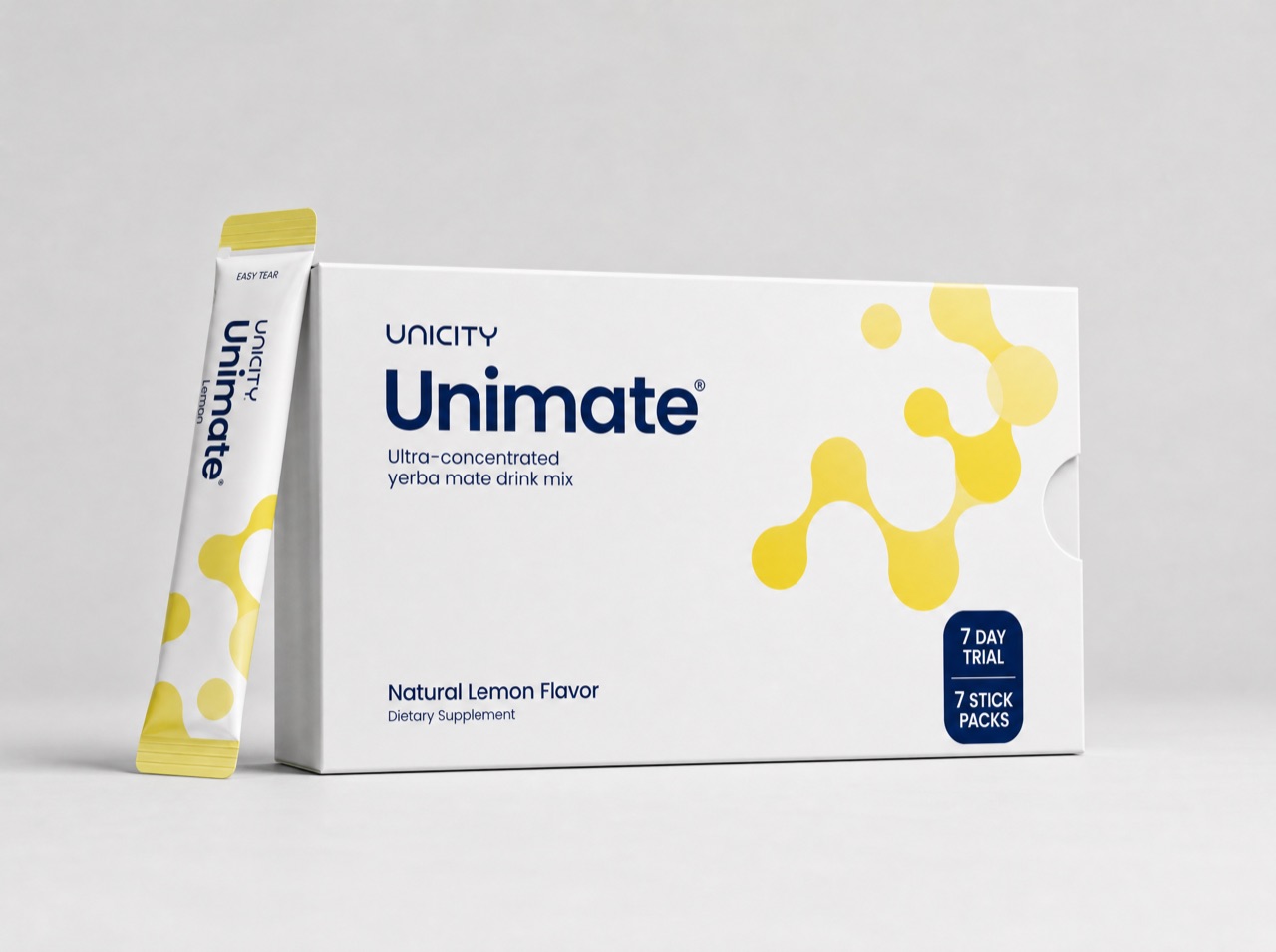
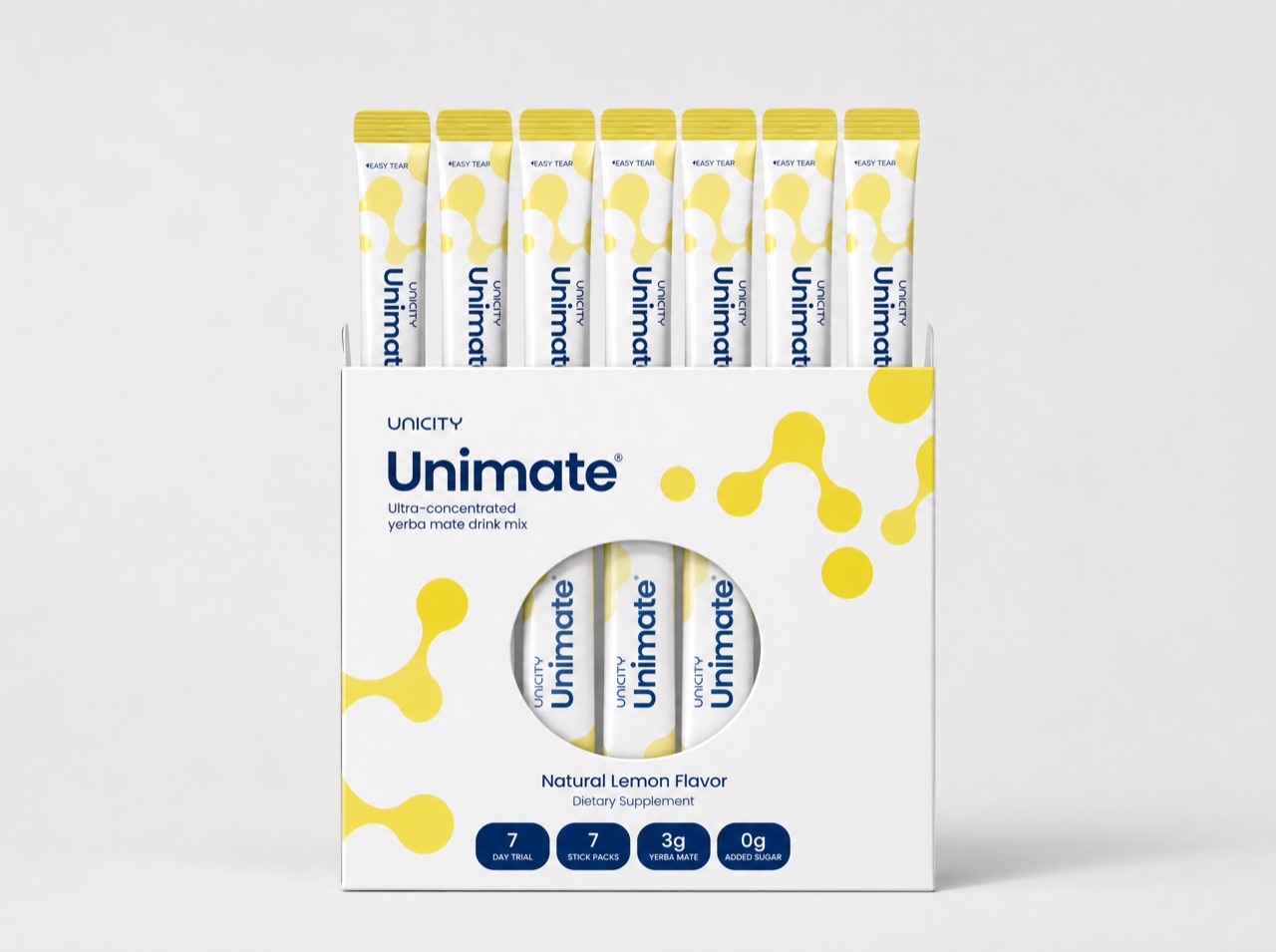
QA ✓Hero. Natural LemonThe closed carton next to a single stick shows how the 7-day trial reads as a slimmer sibling of the 30-count box, with the molecule-shaped window as its one shelf differentiator.QA ✓Open, seven sticks, one rowWith the flap open you can count the seven stock stick packs standing in a single row, proving the carton needs no new stick print and the window shows real product rather than a picture of it.QA ✓Family lineup. Lemon, Raspberry Pomegranate, FierceThree flavors from one cutting die show the cost logic of the concept: pay for the die once (about $350 to $800) and run every flavor as a print change only.QA ✓7 Day Discovery Pack. Mixed flavorsThe variety edition uses the same die and window to let a new customer taste the whole lineup in one week, with the window doing the selling by showing the mixed stick colors directly.QA ✓On shelf. Beside the 30-countSide by side with the $115 30-count, the trial carton shows the retail entry-SKU play and also the risk the research flags: shoppers will compare per-stick price, so the trial needs its own pricing story.
Spec sheet
Structure
Straight tuck‑end folding carton, upright, proportioned like a slim version of the 30‑count, with a die‑cut window shaped as one molecule circle showing the sticks behind a clear patch. Optional hang tab. Insert card slides behind the sticks.
Outer size
6.5 × 3.3 × 1.3 in · 165 × 84 × 33 mm. Sticks standing in two columns (4 + 3). Comparable to DripDrop (2.5 × 5.75 × 1.5 in) and Prime (3 × 6 × 1.25 in).
Board / finish
16–18 pt SBS C1S, aqueous matte, spot UV on the badge stack, window patch. Same layout grammar as the 30‑count: small UNICITY, large Unimate®, three navy pills now reading “7 STICK PACKS / 7 DAYS.”
Motif
Continuity. Same white field, molecule graphic and navy type; the window becomes a molecule. One die serves every flavor, and print alone handles the flavor.
Ships as
Parcel, or packed inside the 30‑count shipper as an add‑on.
$0.65–1.20per unit @ 1k (carton + card)
$0.35–0.75per unit @ 5k
1 die$350–800, shared by all flavors
Why this box
Closest structure to Liquid I.V. 6‑ct, Vital Proteins 8‑ct and Emergen‑C 10‑ct, all proven retail entry SKUs (rows 7, 13, 14).
AG1's Target launch used trial counts on endcaps; a 7 / 30 ladder is a known retail pattern (row 1).
One shared die is the cheapest way to run six flavor versions and a variety edition (pattern 9).
The window is the one departure from category habit (pattern 8), which is exactly what makes it recognizable at three feet.
Risks
Window patches are the most common failure point (fogging, peeling, tearing in transit), and no premium stick brand studied uses one. A printed‑sticks variant should be tested alongside.
A 7‑count next to a $115 30‑count invites per‑stick price math; the trial must be priced and messaged so it does not cannibalize the 30.
Adds a retail SKU that needs a PV assignment and a place in the compensation plan before any distributor will hand it out.
4
Side by side
A mails cheaply; B builds the habit; C makes the gift; D sits on the shelf. Green marks the best answer in each row.
Question
A · First Week, Flat
B · Ritual Carton
C · Welcome Drawer
D · Shelf Window
Structure
Paper sleeve + slotted card
Tuck carton + bi‑fold day card
Rigid drawer box + tray + booklet
Tuck carton + window + card
Outer size (in)
10.5 × 6.5 × 0.45
6.5 × 6.2 × 0.95
7.0 × 6.5 × 1.5
6.5 × 3.3 × 1.3 (smallest)
Unit cost @ 5k (list)
$0.30–0.60
$0.40–0.90
$2.00–4.00
$0.35–0.75
Tooling
1 card die
2 dies
Rigid tooling + tray
1 die, all flavors
Postage
USPS flat ≈ $2
Parcel
Parcel, heavy
Parcel / rides in shipper
Shelf presence
None (cannot stand)
Good (square face)
Gift shelf only
Best: sits beside the 30‑count
Habit mechanic
Day strip on card
Day slots + progress fade + cue copy
Booklet week planner
Card only
Unboxing / share moment
Low
Medium
High (drawer reveal)
Low‑medium (window)
Variety edition
Easy: colored slots
Easy: colored slots
Easy: fanned sticks
Easiest: print only, same die
Biggest risk
Fails USPS thickness rule → parcel pricing
Two dies + hand insertion
Cost ≈ ¼ of trial price
Window patch failure in transit
Best use
Mail programs
Hand‑out + gifting
Gift with subscription
Shop add‑on + retail
5
Recommendation
Pilot D's carton with B's day‑numbered card inside. Hold A for mail programs. Treat C as a gift, not a SKU.
The four concepts answer four different jobs, and the president's question is “which job first.” The shelf carton is the cheapest structure that also works as a distributor hand‑out and an add‑to‑cart item, one die covers every flavor plus a Discovery edition, and dropping B's day card inside it lets the pilot measure whether day‑numbering changes reorder rate before committing to a second die. The drawer box's economics only close as a gift tied to a subscription order; the flat sleeve is the right answer for direct mail once a physical stick has passed the USPS bend test.
D · the cartonSlim window tuck carton. One die serves every flavor and the Discovery edition; smallest footprint, lowest unit cost of the three shelf‑ready structures.B · the card that goes insideThe DAY 1 → DAY 7 insert. Dropping this into D's carton is what makes the pilot measurable: same box, with and without day numbering.
First: close the unknownsMeasure ten real sticks across flavors, confirm how the 30‑count is packed, and get Brandfolder access. Every dimension on this page moves with the stick.
Then: decide the commercial shapeSold SKU, gift‑with‑purchase, or both; price inside the $19–$29 category band; PV assignment; the QR‑to‑cart credit that stops per‑stick price comparison.
Then: one white sample, one quoteOrder an unprinted D carton + B card from a short‑run house (Packlane, PackMojo) with real sticks inside, and get a quoted price at 1k and 5k before any artwork.
6
Before anyone cuts a die
Sorted by how much each item can change the design. The first group blocks the dieline.
Must close before design starts
Exact stick dimensions (length, width, filled thickness). Not published anywhere. Measure ten physical sticks across flavors, including the heavier Decaf Mint Chocolate Brownie stick.
How the 30‑count is packed inside (tray or loose, standing or flat) and which carton format is current. The Feel Great shipper render shows solid‑color landscape cartons that do not match the white upright retail box.
Brand assets. Logo clear‑space, exact hex values, packaging typeface and molecule rules live in a login‑only Brandfolder. Hex values here are sampled; the typeface is a visual match.
Does a trial SKU already exist in any market? 10‑sachet packs on Walmart and eBay could be reseller repacks or an Asian‑market SKU. If official, its dieline and panel are the starting point.
Business decisions the president owns
Sold SKU, gift‑with‑purchase, or both, and its PV. The category sells 6–9 sticks for $8–$20 or gifts 8; AG1 charges $34.99 for 7 plus hardware. Distributors will not hand out a pack that pays them nothing.
Flavor mix. One flavor for seven days (cleaner habit story, simpler pack‑out) or a Discovery pack (category norm, uses the color system, but the brown MCB stick and purple decaf band complicate it).
Cannibalization guardrail. Decide the credit or voucher mechanic (Magic Mind, Sephora, Nespresso) before pricing.
Stock sticks vs. new stick print. All four concepts assume stock sticks. Printing DAY 1–7 on the sticks themselves is stronger but needs a new film run (≈5,000‑impression digital minimum) and a new regulatory review.
Regulatory and compliance
Panel copy. Supplement Facts, net weight for seven sticks, “Dietary Supplement,” distributor address, FDA structure/function disclaimer for any “GLP‑1,” “focus” or “energy” claim, allergen and caffeine statements. Unicity's own pages disagree on caffeine (“about a cup of coffee” vs “100 mg” vs “not standardized”); legal must pick the wording.
Sustainability marks. FSC can only be applied by a certified printer; How2Recycle needs paid membership and applies to the carton only; soft‑touch must be aqueous, not film, for a recyclable claim; California PFAS limits apply if treated as food‑contact.
Numbers to treat as soft
All costs are supplier list prices (Cubit, AXEN, Packlane, Packhelp, PackMojo), not quotes, and exclude dies, plates, freight, hand assembly and hardware.
USPS flat rules come from secondary summaries of the Domestic Mail Manual. Test one physical piece at a post office.
Conversion benchmarks are cross‑category (Boost Drinks 32% via SoPost; Bazaarvoice 63% from an opted‑in panel). Measure with the QR landing page instead of quoting a number.
Amazon dimensions for the current box are seller‑entered, not measured.
The unicity.com “best yerba mate” page lists $2.50/serving and a $45 subscription, which conflicts with shop pricing ($115 / $79). Correct or explain that page before a trial pack points customers at it.
7
No‑ship packaging: paper instead of board
Added after the president sent a new
constraint. The four concepts above are unchanged and still stand for anything that has to ship or sit
on a shelf; this section answers the different question he asked instead.
“I think that one is set up for shipping, so it's cardboard and big enough for a shipping label. But for what we need, it doesn't have to ship. It's going to be mostly sold in person. We'll flat pack and ship them as part of the 10pack.”
“So instead of cardboard, it could be a paper print with lots more color.”
— the president, 2026‑08‑28
No shipping label, no carton strengthThe pack is handed over in person, so it does not need a flat panel sized for a label, board stiff enough to survive a parcel network, or any postal thickness rule. That was the single biggest constraint on the four concepts above, and it is now gone.
It travels flat, inside the 10-packDistributors receive these bundled with a 10-pack, so the outer carton does the protecting. Each trial pack only has to arrive flat and look good in a hand, which is exactly what paper is for.
Color can go all the way upThe white field on the retail box exists so the box reads calmly on a shelf beside its siblings. A pack handed to one person across a table has no shelf to compete on, so the flavor color can run edge to edge, giving the president's “lots more color.”
Four paper formats
Each holds the same seven stock stick packs
and arrives to the distributor flat. Costs are supplier list prices for printing, not quotes, and exclude
dies, freight and the labour of filling each pack.
QA ✓
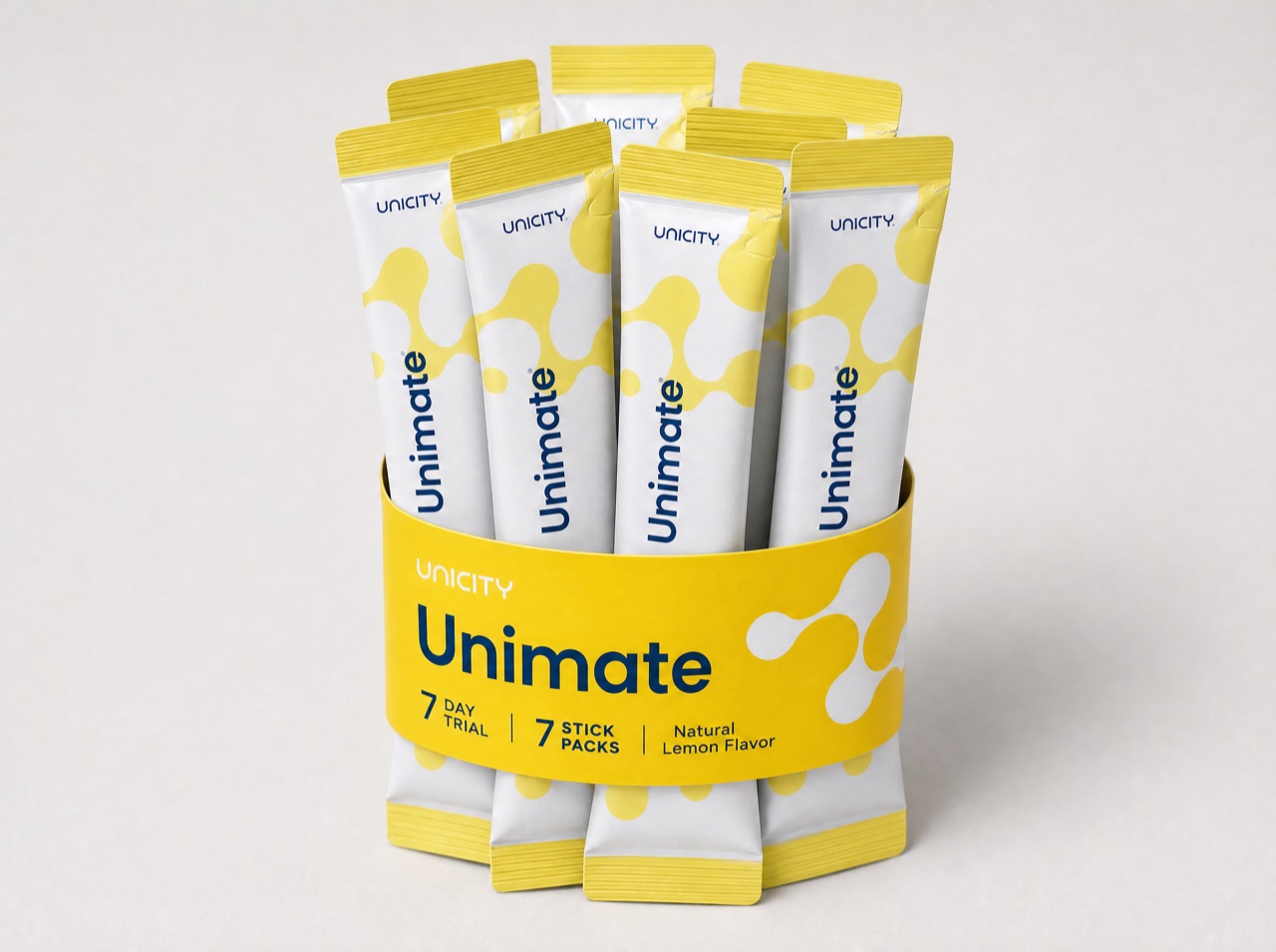
Paper band around a bundled seven Printed paper belly band
What it is. A strip of printed paper about 7 inches long and 2.5 inches tall, wrapped around the middle of a stack of seven stick packs and closed with a glue tab or a peel-and-stick strip. Stock is roughly 100 lb silk-coated text, a sheet a little heavier than a magazine page, matte, not board. It holds the bundle by friction alone: the tops and bottoms of the sticks stay exposed. It ships dead flat in a stack, and someone wraps it around the sticks at the fill site.
Why it fits. This is the cheapest way to obey the president's brief. No board, no shipping strength, and the entire surface can be one saturated flavor color. Field Notes has sold three-notebook packs held together by nothing but a paper band for years, so the format is proven as a primary pack. Because it never mails, we can use uncoated or heavily-inked paper that would scuff in transit.
Risk. A band around loose sticks does not stop them sliding out sideways. Bands work on rigid, same-sized contents (notebooks, soap); flexible foil sticks are the worst case. This needs a second cross-band or a folded paper tray underneath before it survives a distributor's bag, and it adds a hand-wrapping step at pack-out with no protection in return.
Cost Supplier list prices, not quotes we've received: Ryt Packaging starts at $0.40/unit at 100 pieces and Teal at $0.44 at 50. Estimated at our volumes, a plain 2x7-inch band gang-run in four colors is roughly $0.06-$0.12 each at 1,000 and $0.03-$0.06 at 5,000, plus about $0.03-$0.06 for the peel-and-seal adhesive. Cheapest of the four formats per unit.
QA ✓
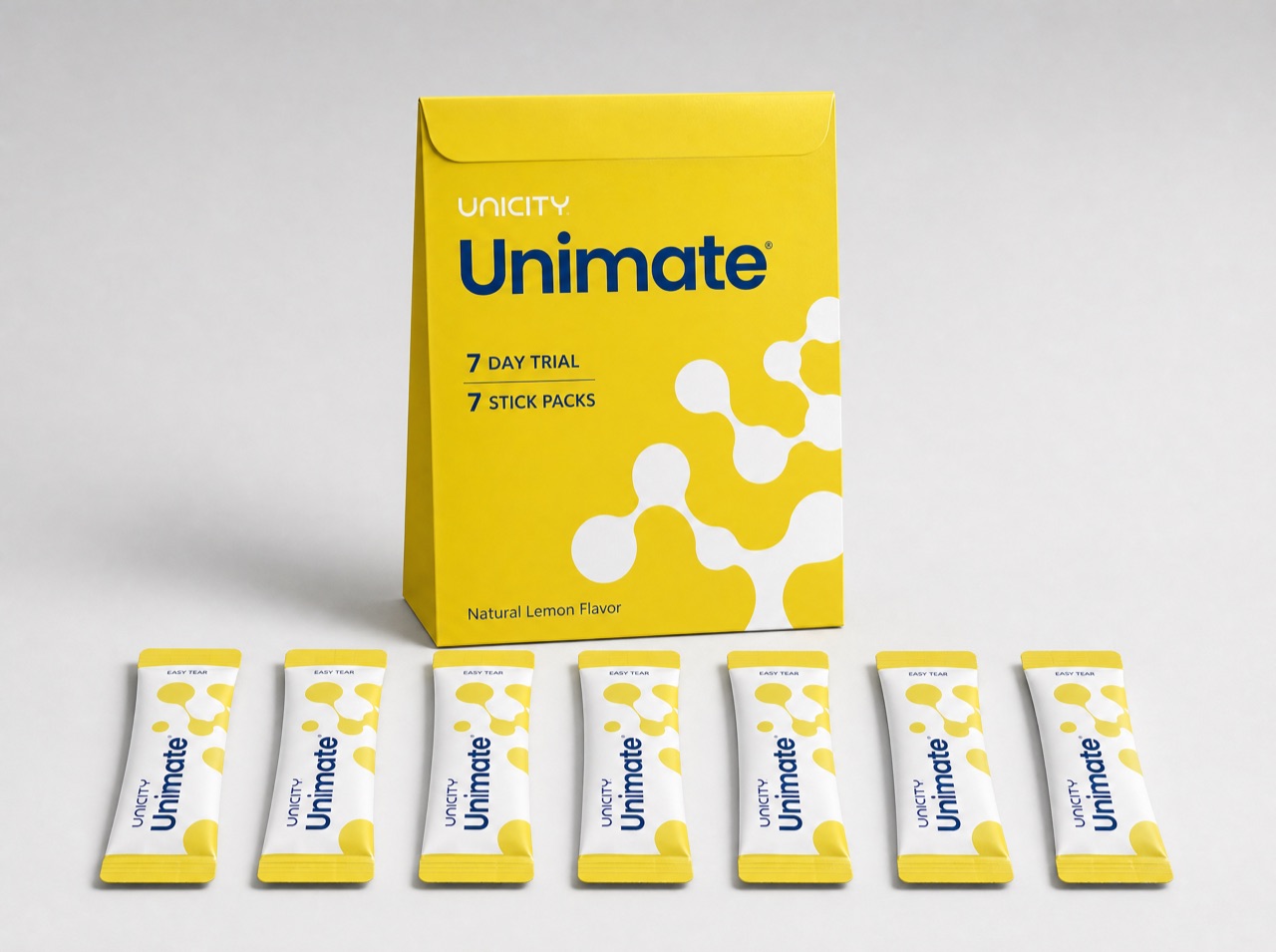
Seed-packet envelope in full flavor color Printed paper envelope (seed-packet style)
What it is. A single sheet of paper die-cut, folded and glued into a pocket about 4.5 by 6.5 inches, the same construction as a garden seed packet. Printed in full color on both faces on coated paper, sealed at the top with a peel-and-stick strip. It arrives flat and empty, nested in cartons, and gets filled and sealed on a line later. Opaque, so both sides are usable printing space for the story, dosing and a QR code.
Why it fits. An envelope is the only one of these four that fully encloses the sticks without a custom die and without an assembly step at the distributor. It reads as craft rather than factory. Hudson Valley Seed Company built a whole brand on the artwork of the packet itself. Because it never ships on its own, we can flood the whole packet in flavor color instead of reserving a white patch for a label.
Risk. The 5,000-unit floor is the trap. Ordering 1,000 costs the same as ordering 5,000, so a small first run is the worst possible quantity. Also, seven sticks stacked flat are about 1.6 inches thick, a flat glued pocket will not close over that. This needs a gusset (expanding side folds) or the sticks laid side by side, which makes it a wide envelope, not a small one.
Cost Supplier list prices and published minimums, not quotes: JBM Packaging requires 5,000 units total with 1,000 minimum per design, and publishes no prices. Quote only. Estimated at roughly $0.06-$0.15 each at 5,000 for four-color on white wove; more on coated stock. Short-run digital shops advertise no minimum but at meaningfully higher per-unit prices, useful only for prototypes.
QA ✓
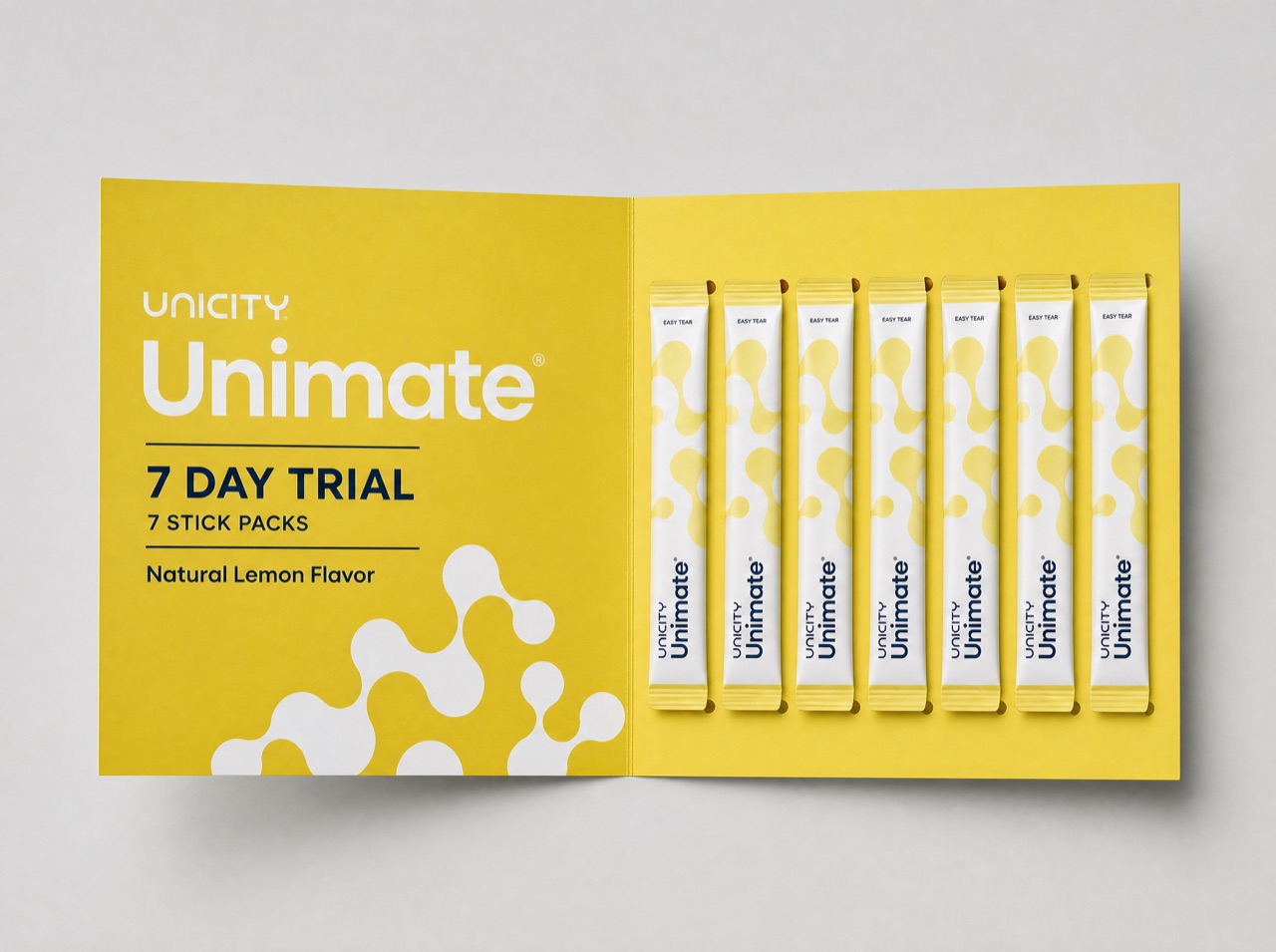
Folded wallet, opened Folded paper wallet with die-cut slits
What it is. A flat printed card, roughly 8.5 by 4.5 inches open, scored down the middle and folded like a greeting card or a menu. Cut into the inside panel are seven pairs of small slits; each stick slides into a pair and is gripped by the paper. Stock is about 14pt coated one side, stiff card, not board. It ships completely flat and scored; the distributor or the fill site folds it and slides the sticks in. Closes with a tuck tab, no glue needed.
Why it fits. This is the only format here that both encloses the sticks and gives one large uninterrupted printed surface to hand over like a menu. The slits cost nothing extra. They are cut on the same pass as the outline, and the whole inside panel becomes a seven-day calendar the customer works through. Honest caveat: this is borrowed from gift-card holders and cosmetic sampling, not from any supplement brand.
Risk. Die-cut slits alone let contents work loose over time, and a foil stick is slick and floppy, worse than the rigid cards this mechanic was designed for. It needs a tuck flap or a band over the slit field. Separately, flooding solid color across a fold cracks the ink along the crease and shows white fiber; that is fixed by scoring correctly and a matte laminate at about $0.03-$0.08 a unit.
Cost Supplier list prices, not quotes: UPrinting's french-fold brochure is $114.93 for 250. Estimated at stick-pack size on 14pt, about $0.15-$0.28 each at 1,000 and $0.09-$0.18 at 5,000 for print, score and fold, plus roughly $0.03-$0.08 per unit for the die-cut slits and a one-time cutting die charge of about $350-$1,500 depending on how fussy the shape is.
QA ✓
Paper pouch with a folded header card Paper pouch + folded-over header card
What it is. Two pieces. A small flat paper bag holds the seven sticks; a printed card is folded in half over the bag's open top and fastened with two staples or a strip of double-sided tape. The header card is about 4 by 4 inches folded and carries the whole brand face, front and back, and can be printed on the inside too. Both pieces ship dead flat and separate; nothing is assembled until someone assembles it.
Why it fits. This is the small-batch look. It reads as made by a real company rather than stamped out by a factory, and it is the most explicitly flat-packing of the four. The header is a second printed surface at the exact moment the customer opens it, so dosing instructions live where they are read. It is also the only format we could prototype for real money this week.
Risk. The assembly never goes away. Every single pack needs someone to fill a bag, fold a card and drive two staples. That is fine at 500 units and painful at 5,000. Price the labor before the paper. A stapled pack also looks handmade, which cuts both ways: charming at a home event, off-brand next to the current retail box.
Cost The one hard published number in this research: UPrinting lists $81.38 for 1,000 header cards at 4x4 inches on 14pt. $0.08 each, and roughly $0.04-$0.06 at 5,000. A small kraft or glassine bag adds about $0.05-$0.15. But the real cost is labor: at 15-20 seconds a unit, 5,000 units is 25-35 hours of hand assembly, which at $18/hour adds another $0.09-$0.13 a unit and can double the true cost.
Color, and the moment it is handed over
QA ✓Four flavors, four full-bleed colorsThe same paper wallet in four flavor colors, side by side. This is what "lots more color" looks like on a table.QA ✓Handed across the tableThe pack being handed over at a kitchen table, the whole reason it doesn't need to survive shipping.
Three things that decide this, from the print research
The cheap way to get color is flood aqueous coating
It is applied inline on the press at full speed and costs close to nothing, in gloss, satin or matte.
Spot UV, the glossy‑patch effect people usually ask for, costs four to ten times the cost and can add up to
40% to a $0.50 unit. Get the color from full ink coverage plus flood aqueous, not from expensive finishing.
Heavy color plus a fold equals cracking
Solid ink that wraps across a crease splits along the fold and shows white paper through the color, which
reads as cheap. It is the exact tension between “lots more color” and “flat pack.” Scoring is part of the die
and nearly free; film lamination is the only complete fix at $0.03–$0.08 a unit, but it makes the piece
non‑recyclable. The cheapest insurance is a physical folding dummy on the real stock with the real ink
coverage before anyone commits to a die.
Labour is the hidden cost, not materials
Every format here arrives flat, which makes it cheap to freight. Flat also means somebody folds it,
loads seven sticks and closes it. At these prices the paper is cents and the handling is the real line item.
Tab‑and‑slot closures that need no glue and no stapler are worth specifying for that reason alone.
Six more, from expo tables and living rooms
Where the four above start from the
material, these start from the moment. A stranger at a booth who has ten seconds, and a
distributor working a room of eight people who already know her. Each one borrows a mechanic that a real
company already uses. They are sketches rather than worked formats: the reasoning and the precedent are
real, the dimensions are first estimates.
QA ✓
The Share Card
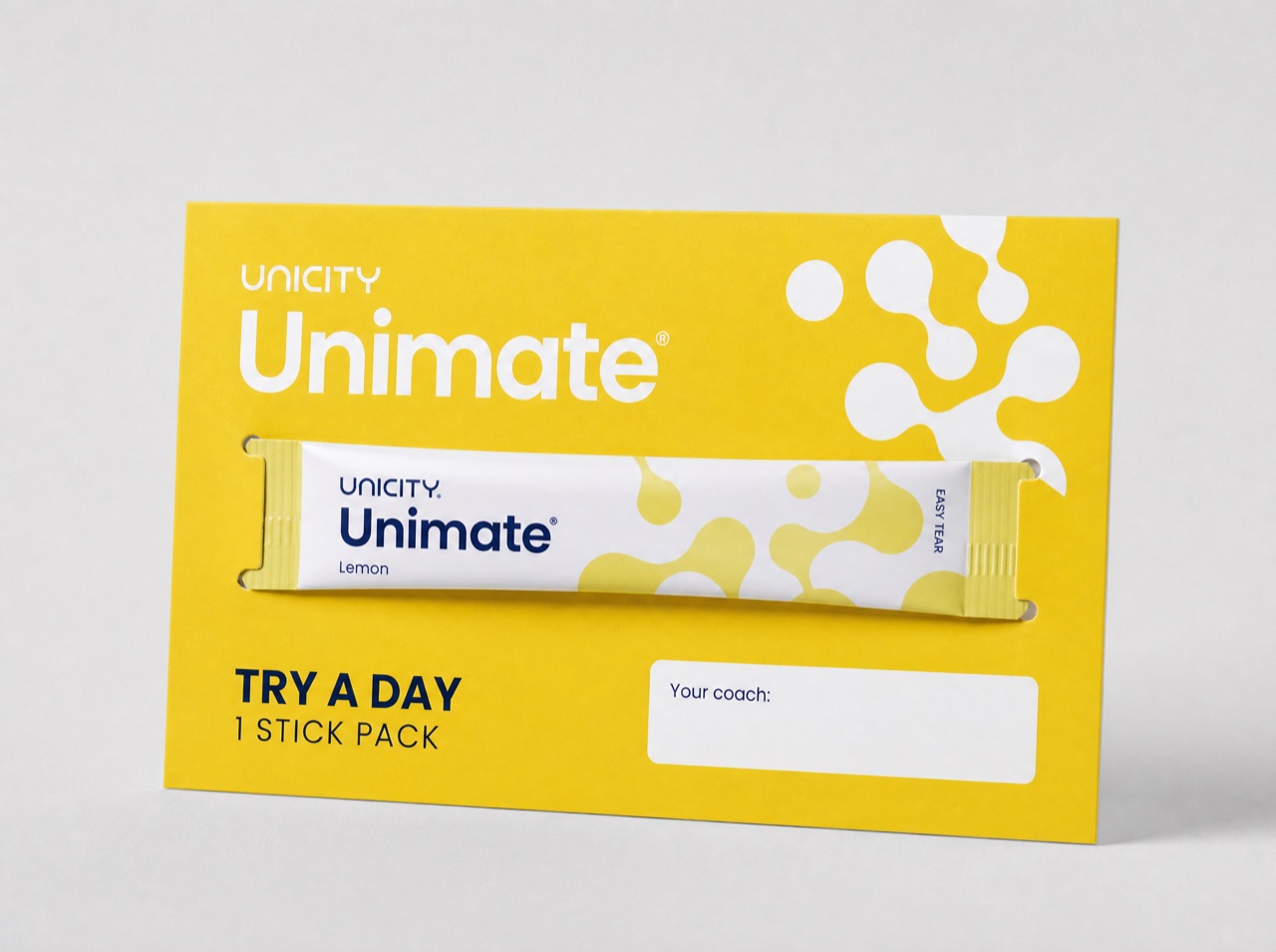
Single-stick share card, 6.25 x 2.75 in
Borrowed from: AromaTools' doTERRA sample cards and Young Living's Sample Sachet Business Cards, a printed card the sample is physically attached to, with a blank for the distributor's name.
A flat paper card about 6.25 inches wide and 2.75 inches tall, printed on uncoated card stock roughly the thickness of a postcard. Two small angled cuts hold one Unimate stick across the face, so the stick slides out and the card stays. It is a single flat piece of paper, so a hundred of them stack about as thick as a paperback and travel loose in a bag.
The research is blunt about what kills a loose sample: the person forgets what it was, how to use it, and who gave it to them. A card fixes all three because the instructions and the name travel with the stick. It is also the only format here cheap enough to leave in a bowl at an expo booth or hand over at the end of a two-minute conversation without thinking about cost. Trade show data cited in the research puts free samples as the number one reason someone walks into a booth at all.
Cost Roughly 25 to 50 cents per card, before the stick. Company Folders publishes printed card holders from 21 cents each at minimums between 50 and 2,500 units; AromaTools sells the doTERRA equivalent at about 29 cents. These are published list prices off supplier websites, not quotes we asked anyone for.
Risk One stick may not be enough. Yerba mate's benefit is described as cumulative, so a single serving may not produce the effect that sells a second purchase. This format wins on cost and loses on proof.
QA flag: render shows loose sticks in the pocket where it should hold folded trial packs
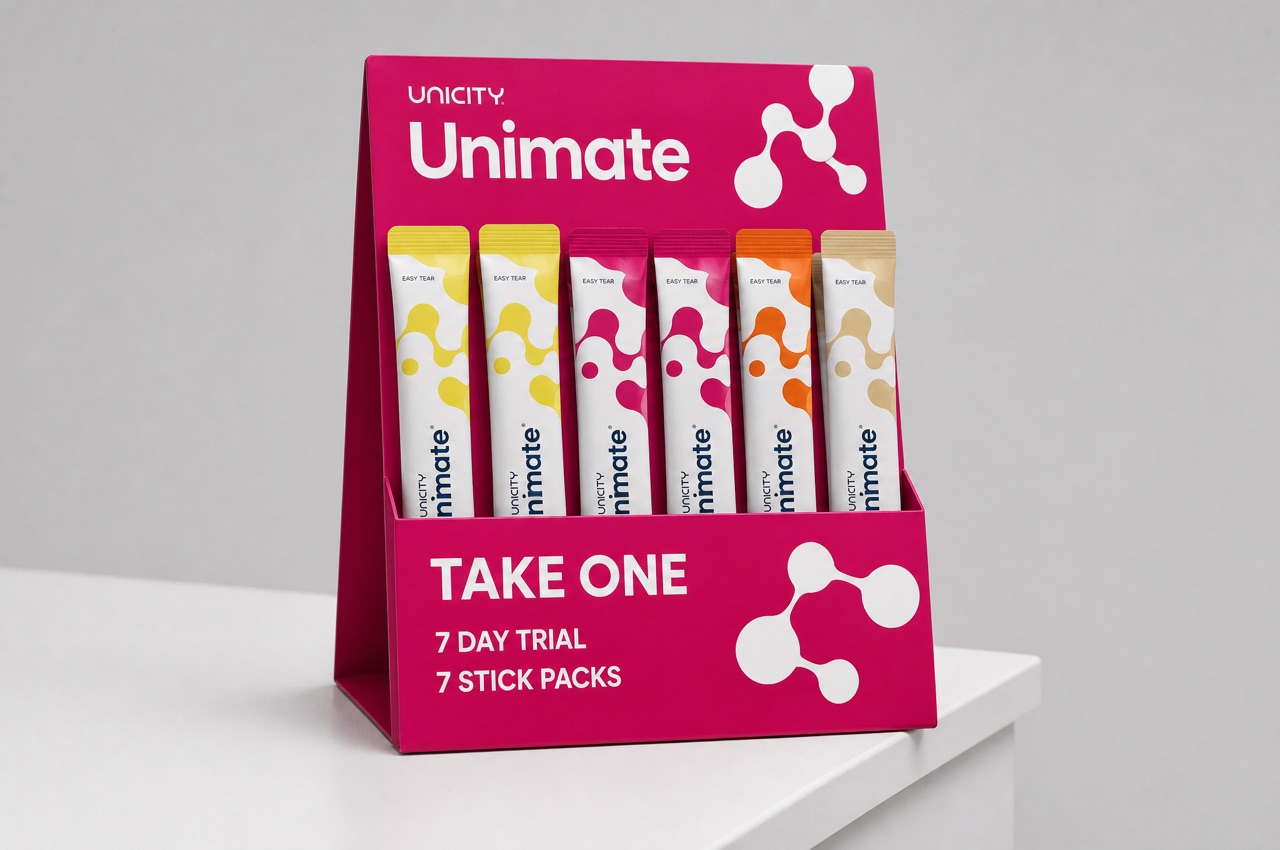
The Take-One Tent
Folded paper counter tent holding six trial packs, 5 x 7 in
Borrowed from: Dilco easel-back counter cards and the 'take one' cardboard rack holders sold by Affordable Display Products, crossed with the PDQ counter tray that arrives holding its own product.
One sheet of stiff paper, scored and folded into a triangle that stands on its own with a pocket across the front. It is about 5 inches wide and 7 inches tall and holds six flat trial packs upright, faces forward. It ships dead flat inside the distributor's own box and the distributor folds it in about ten seconds. No glue, no easel part, no assembly instructions.
This is the expo table and the gym front desk in one object. The research is clear that samples lying loose on a table read as staff property and go untouched, while a container that holds them upright and says 'take one' gives a stranger permission to take one. Because it is one folded sheet, it costs a fraction of a display box and it is the only format here that keeps selling while the distributor is talking to someone else.
Cost Dilco lists 5x7 easel-back counter cards at $2.30 each for 250 and $1.51 each for 1,000; UPrinting lists folded table tents from $3.83 each at a 25-piece minimum, dropping sharply with volume. A folded tent needs no easel part, so it should land under the easel prices. Published supplier list prices, not quotes we obtained.
Risk An unattended take-one display empties fast and teaches you nothing about who took the packs, so the pack itself has to carry the follow-up code, the display will not capture a single name on its own.
QA ✓
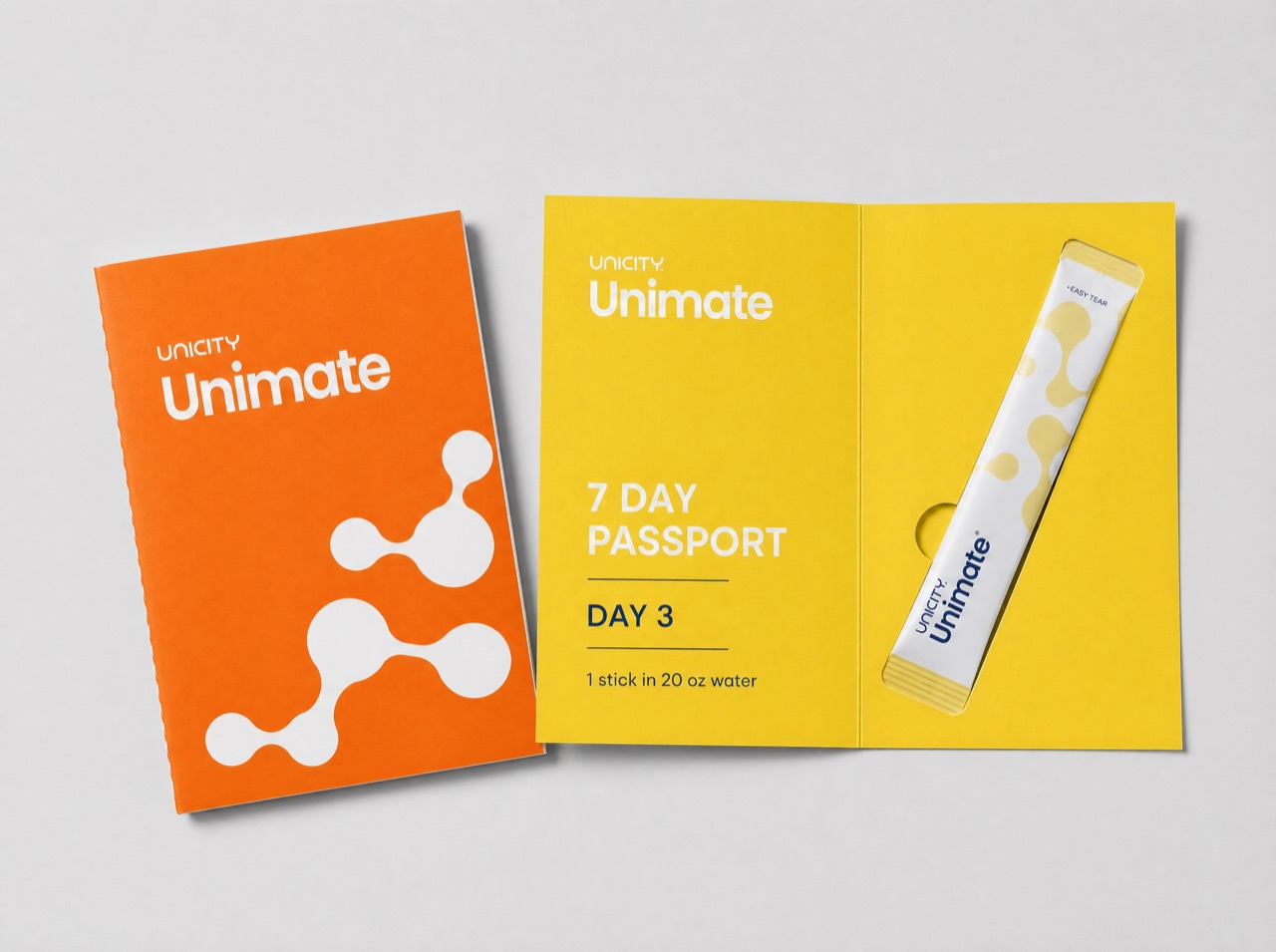
The 7-Day Passport
Stitched mini booklet, 3.75 x 6 in, 16 pages
Borrowed from: The Rodan + Fields 'mini facial' card that stages one ritual in sequence, plus the day-by-day check-in formats published for It Works! distributors ("one product each morning, one check-in text each afternoon").
A small stitched booklet about 3.75 inches wide and 6 inches tall, printed on uncoated paper with a slightly heavier cover. Each spread is one day, Day 1 through Day 7, and each right-hand page holds one stick tucked into a die-cut slit. The last spread is the distributor's page and the reorder code.
This is the only format that paces the seven days instead of dumping them. The customer cannot see all seven at once, so each morning is a small reveal and the coaching line arrives at the moment they are drinking it. Every direct-selling sampling format in the research pairs the physical object with a scripted daily touch, the booklet builds that rhythm into the paper itself, and seven pages means seven natural reasons to text.
Cost The expensive one. Saddle-stitched booklets are generally quoted at $2 to $8 per unit, and attaching the sticks is hand assembly on top. A small 16-page booklet at high volume would land well below that, but no supplier publishes that tier. This one needs a real quote. Everything else here is published list price.
Risk Cost and assembly. A booklet that costs several dollars plus hand-fitting seven sticks is not something a distributor hands out freely. It is a paid trial or a gift for a booked appointment, and it will not survive as a giveaway.
QA ✓
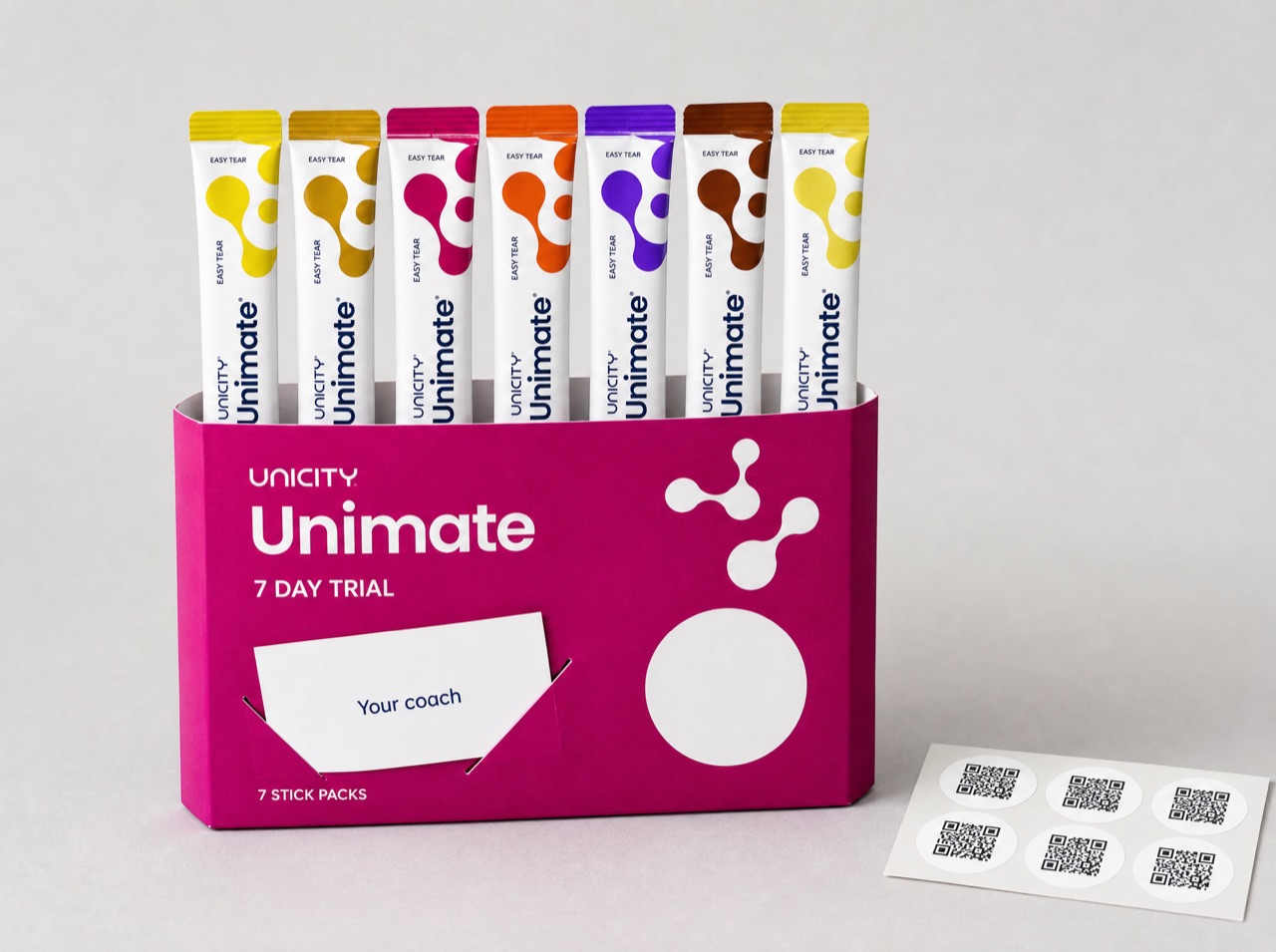
The Coach Slot
7-stick paper sleeve with card slit and sticker target, 4.5 x 6.25 in
Borrowed from: Company Folders' business-card die-cut slits, plus the peel-and-place QR stickers Arbonne and Plexus distributors already buy for themselves from Sticker Mule and Etsy sellers.
A paper sleeve about 4.5 by 6.25 inches holding seven sticks, printed on 300gsm uncoated stock. Two angled cuts on the front hold the distributor's own business card, and a printed white circle marks where they stick their own QR label. Corporate prints one design forever; the distributor adds their identity at the moment they hand it over.
This is the cheapest way to make one print run serve every distributor in every market. The personalisation cost moves onto the person who benefits from it, nothing has to be reprinted when a distributor quits, and the company keeps control of every claim on the pack because the distributor only ever touches the name and the link. The research flags distributor-made marketing as a standing compliance headache. Supplying the template is the defensive move as much as the marketing one.
Cost The slit is a standard die option, effectively free per unit. Sticker Mule lists die-cut stickers at 30 cents each for 500 and 23 cents for 1,000, bought by the distributor. Personalised card artwork sells to distributors at $8 to $12 a file today. Supplier list prices, not quotes we obtained.
Risk A loose card falls out of a handbag and the personalisation is gone. The slit should never be the only place the contact detail lives. Pair it with a printed generic code on the pack.
QA ✓
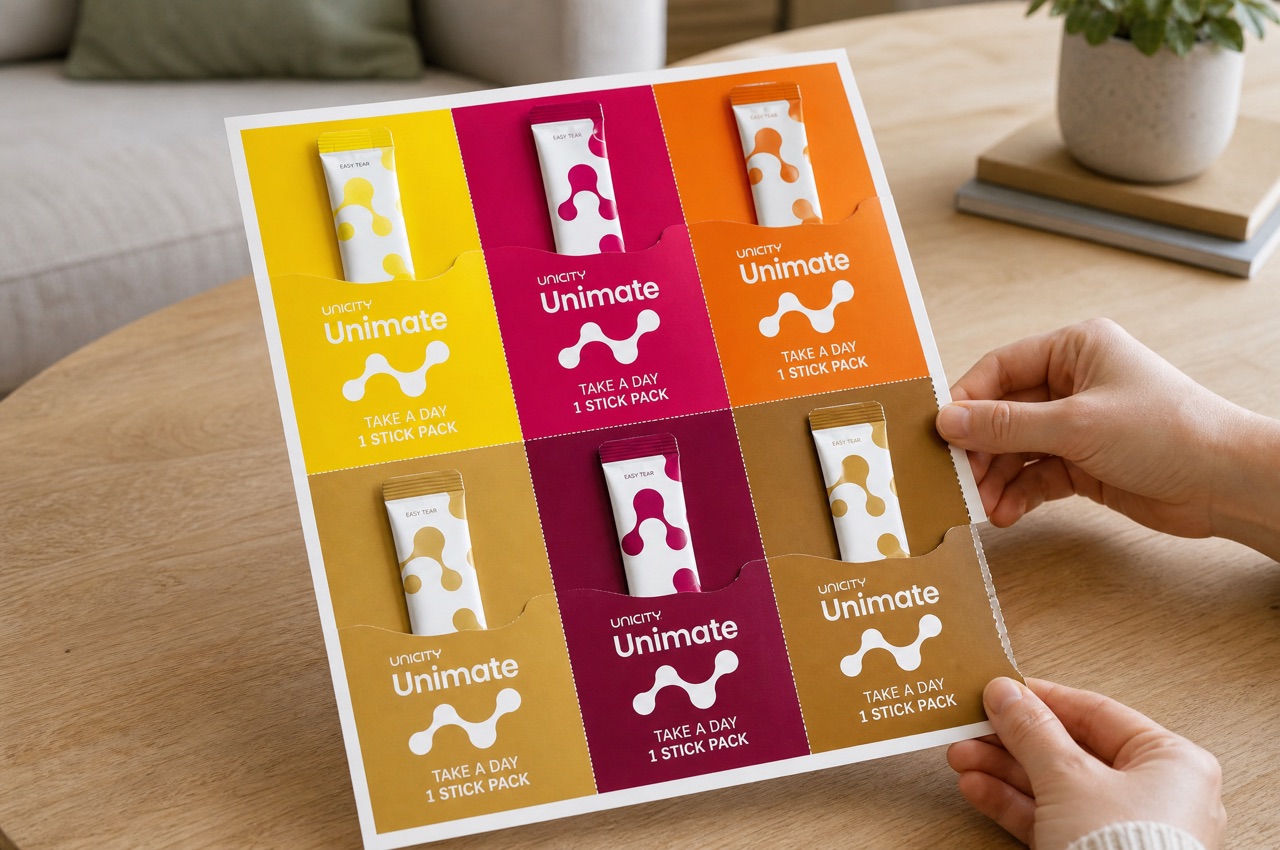
The Tear-Apart Sheet
Perforated paper sheet, 8.5 x 11 in, tears into six single-stick pockets
Borrowed from: Mary Kay's samples sold in packs of 3, 6 and 12 so a consultant can hand one to every guest at a table, and the party-plan convention of a favor every guest leaves holding.
One printed sheet of paper the size of a letter page, perforated into six small pockets. Each pocket holds one stick and each is a different flavor color. The host tears them apart at the table and hands them round. Flat as a sheet of paper until the moment it is used, so a distributor can carry twenty in a folder.
Herbalife's shake-party guidance says the sale dies if the guest leaves empty-handed, and party-plan companies solve it by having a favor for every seat. This sheet is that, in the cheapest possible material. Tearing one off in front of someone is a small ritual that makes the handoff deliberate rather than casual, and six different colors turns it into a choice, which flavor do you want. Instead of a handout.
Cost Perforation is a standard finishing option on a normal print job, with typical short-run minimums of 250 to 500. A letter-size full-color sheet is a few cents; the cost sits in the six sticks, not the paper. Published supplier terms, not a quote we obtained.
Risk Flimsy. A perforated paper pocket holding a stick will not survive a handbag the way a sleeve does, and once torn apart the six pieces carry no reason to be kept. This is a favor for the room, not a take-home that lasts a week.
QA ✓
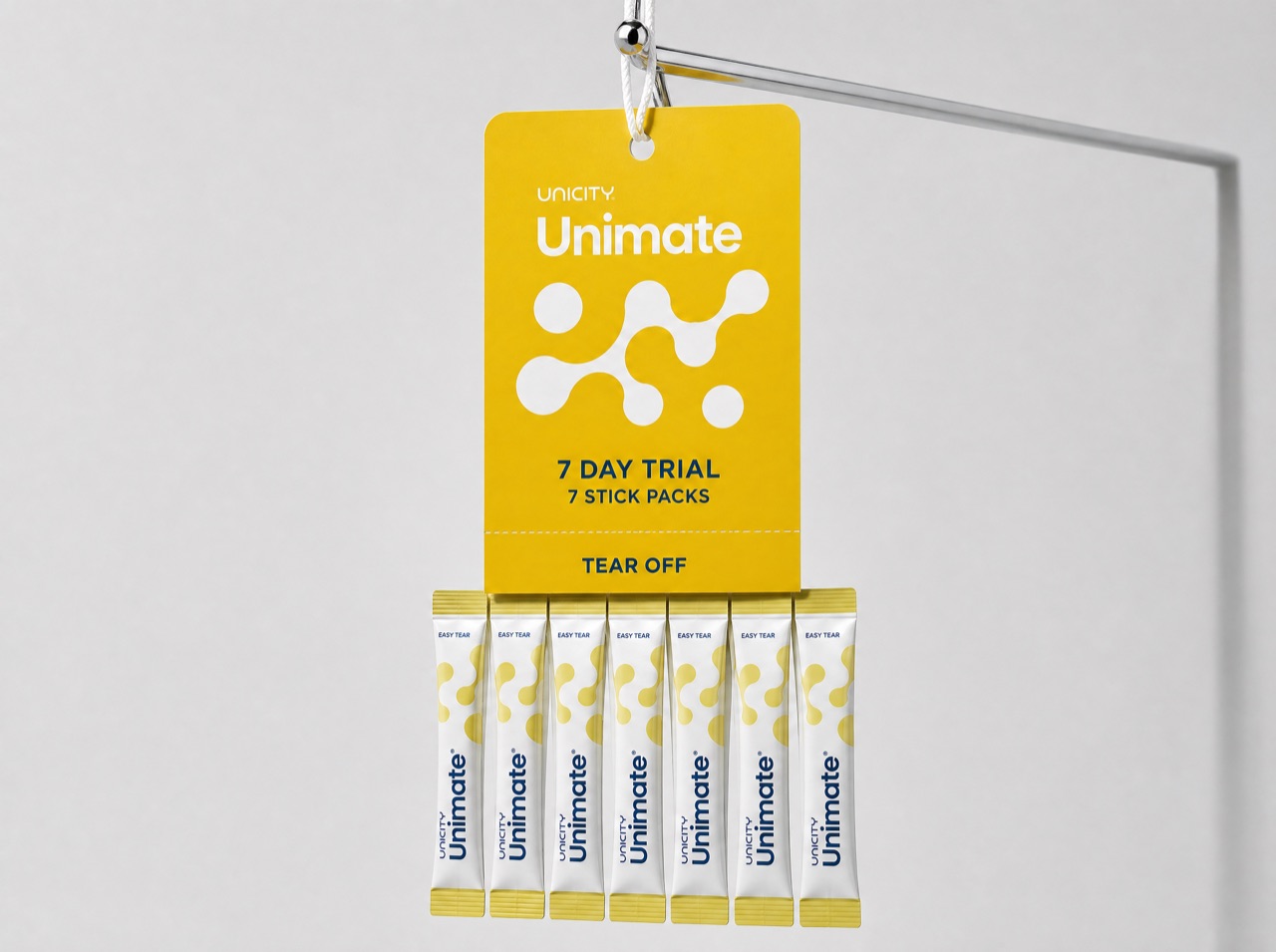
The Hang Tag
Strung paper hang tag over a banded 7-stick bundle, 3.25 x 7 in
Borrowed from: 4OVER4's printed kraft hang tags and the door-hanger format with a perforated tear-off card that the recipient keeps after the product is gone.
A tall paper tag about 3.25 by 7 inches, punched and strung with a cotton loop, sitting over a banded bundle of seven sticks. The bottom third of the tag is perforated so the customer tears off a business-card-sized piece with the code on it and keeps it. Hangs on a peg hook, a gym locker, or the handle of an event tote.
Almost nothing here can hang. A tag can, which turns a trial pack into something a gym, a salon or a market stall can display on a hook without any fixture, and it fits a conference tote handle where a flat pack disappears into the bottom of the bag. The tear-off is the point: the sticks get used and thrown away, and the code survives because the customer chose to keep it rather than having it forced on them.
Cost 4OVER4 lists printed kraft hang tags starting around $58 for the entry quantity, with tiers up to 25,000; door hangers with a perforated tear-off run roughly 17 to 31 cents each at 500 to 1,000. The string and the banding are extra assembly. Published list prices, not quotes we obtained.
Risk The tag brands and hangs but it does not contain. Seven sticks held by a paper band will slide out in a bag, so this needs a proper band or a glued end. That detail decides whether it works at all.
One format worth naming that did not make the four:
glassine, the translucent, grease‑resistant paper used for seed packets and chocolate. It is genuinely
lovely, food‑safe without any plastic coating, and compostable. Two facts rule it out for this brief: its dense,
non‑absorbent surface takes saturated full‑bleed color badly, and custom printing starts at 25,000 units. If the
president ever wants a quiet, natural‑looking pack instead of a colorful one, it becomes the first choice.
Still unresolved, and it matters more here than above:
a paper pack has to hold seven sticks without a rigid box around it, so the closure (glued pocket, die‑cut
slit, fold‑and‑tuck) is the whole engineering problem. That cannot be settled from a render. It needs one
physical sample with real sticks in it. The stick dimensions are still unmeasured.
Where this comes from
Eleven research passes ran behind this page, each pointed at a different question: how Unimate is
packaged today, how sixteen comparable brands price and package a five‑to‑nine‑stick trial, what a
seven‑stick carton costs to manufacture, what premium sample packaging looks like now, which paper
formats hold up when a pack never ships, and how companies sample at expo booths and in‑home parties.
Every claim carries a source link and a confidence tag. Verified means someone read it on the page
it came from; likely means a reputable second‑hand source said it; inferred means we did the
arithmetic ourselves.
What the research cannot supply is the part only Unicity holds. No printer has quoted this job, nobody
has held a physical sample, and the official brand files sit behind a login we do not have. The prices on
this page are printers' published list prices, which is not the same as a quote, and the box dimensions
rest on an estimated stick size. Treat the reasoning as sound and the numbers as a starting point for the
conversation with a supplier.
Sources: 229 links used in the research (click to expand)